

Contents
1 Niru’s Editorial Insight
PsychLab ’26: What happens when you make psychosocial safety a lab, not a conference?
2 Regulator Update
Slips and trips start with decisions about work
3 WHS Prosecution Watch
Access to machinery is an organisational decision
4 Industry Voices
The workplace an injured worker returns to
5 WHS in South Asia & Oceania
Nepal connects chemical policy with workplace practice
6 WHS Research
Reading the new exposure survey without overstating it
7 Emerging WHS Trends
When a cyber incident affects physical safety
8 Capability Focus
Investigating the conditions behind an incident
Final Word • References
Sources checked 29 September 2026
Section 1: Niru’s Editorial Insight
PsychLab ’26: What happens when you make psychosocial safety a lab, not a conference?
On 18 September, Felix Hall and I brought PsychLab ’26 to Brisbane1.
The premise was deliberately different.
We did not want another psychosocial safety event where people spent the day sitting in rows, listening to experts and leaving with a collection of slides.
We called it a Lab because we wanted people to examine ideas, challenge them, work with them and contribute something themselves.
Even the design of the event reflected that. We created a separate speaker retreat and sensory space, while the program moved from morning talks into practical workshops and a closing synthesis.
The conversations were deliberately broad.
We heard about traumatic exposure and the relationship between burnout and workplace hazards. Burnout was not treated simply as an individual wellbeing problem, but placed alongside the conditions of work that can create or compound risk.
The lightning talks then pushed further into areas that can be missed in conventional psychosocial risk discussions: autistic burnout, hazards that are rarely discussed, emerging hazards that may not yet sit neatly on a standard list, psychosocial leadership and the different ways people can experience the same workplace.
That breadth mattered.
Psychosocial risk does not arrive in organisations as a tidy list of thirteen hazards. Real workplaces are messier than that. Exposure is shaped by the interaction between work design, leadership, organisational systems, individual circumstances, communication, change, relationships and the environment.
That became even clearer in the second half of PsychLab.
Instead of continuing with presentations, participants moved into workshops exploring whether we can actually see the risk, the relationship between performance and psychosocial safety, and systems thinking. The program then moved into Every Hazard Mapped, asking participants to work with risk rather than merely hear about it.
For me, that was one of the most important lessons from the day.
We are getting better at talking about psychosocial hazards.
The next maturity step is getting better at thinking about risk.
That means distinguishing hazards from outcomes. Understanding exposure. Looking at how hazards combine. Testing whether controls actually change the conditions creating the risk. And recognising when something that presents as an individual issue is being produced by a much larger organisational system.
It also means accepting that WHS does not have all the answers.
Psychologists, WHS practitioners, mental health professionals, leaders, researchers, people specialists, students and people with lived experience see different parts of the same problem. PsychLab was deliberately created as a space where those perspectives could meet rather than compete.
That was visible not only in the sessions, but in the conversations around them.
And that is where we want PsychLab to go next.
The event was never intended to end when everyone left the room. We are now working with speakers and volunteers to turn the ideas, questions and reflections from the day into a shared practitioner resource.
Not a glossy conference summary.
Something people can actually use.
A huge thank you to everyone who contributed to the day, particularly our speakers, volunteers and participants, and to Risk Training Professionals, Proteqt and Foremind for backing what was still very much an experiment.
PsychLab was an experiment.
It worked.
Now the more interesting question is what we build from it.
Section 2: Regulator Update
Slips and trips start with decisions about work
On 29 September 2026, Safe Work Australia released its Guide to managing the risks of slips, trips and falls. The announcement reports 32,000 serious workers’ compensation claims arising from these events in 2024-25 and explicitly connects prevention with how work is organised and managed.5
The new material is national guidance from Australia’s WHS policy body. Its publication does not itself create a new Queensland duty or make it a Queensland approved code. Existing duties continue to apply, including the PCBU’s duty to provide and maintain safe work environments and systems, so far as is reasonably practicable.1
The guide covers falls at the same level and from smaller heights. It expressly excludes situations involving a risk of falling more than two metres, for which other guidance and jurisdictional requirements must be considered. That scope is useful when assigning the resource to managers responsible for everyday premises and work activities.6
What deserves executive attention is the guide’s treatment of high job demands. It identifies time pressure as a contributor to slips, trips and falls and examines planning decisions alongside flooring, lighting, stairs and other physical conditions.6 An organisation investigating a fall therefore needs to examine the job as well as the surface.
Consider a hospitality operation cleaning a busy service corridor while meals and supplies continue moving through it. The floor condition is the immediate hazard. The arrangement that requires cleaning and service to occupy the same space at the same time is also relevant. A warning sign does not decide who can close the route, where workers should go instead or how service will continue.
The same question arises in an office when maintenance leaves trailing leads across the only practical access route. Facilities may control the equipment, the business unit controls room bookings, and another party performs the work. Unless someone coordinates the activities, each party can complete its assigned task while leaving an unsafe shared space.
Leaders should use the new guide to examine one recurring problem location under actual operating conditions. Include the workers who clean, maintain and use it. Ask when contamination occurs, how long it remains, what creates pressure to pass through and who can authorise a different arrangement.
Select controls against those conditions. Repairing the source of a leak, improving drainage, changing access or scheduling incompatible activities separately may address repeated exposure. The appropriate combination depends on the workplace. Where temporary controls are necessary, identify their owner and the trigger for restoring normal access.
The management task is to connect purchasing, maintenance and operational decisions. If a floor requires cleaning so frequently that people are continually exposed during service, review its suitability and the process causing the contamination. A cleaning frequency target alone cannot resolve that design problem.
Retain observations from busy periods, worker feedback, the reasons for control selection and evidence of completed changes. Review whether the hazard returns during the next comparable shift. An inspection conducted only after cleaning may provide a misleading picture of the exposure workers experience throughout the day.
Boards should ask whether repeat locations have funded improvement plans and accountable operational owners. The useful question is specific: which recurring slip or trip exposure has management removed at its source, and what evidence shows the change holds during normal demand?
Section 3: WHS Prosecution Watch
Access to machinery is an organisational decision
Two September releases from WorkSafe Victoria examine access to dangerous machinery in very different settings. One records a conviction. The other announces charges. Their legal status matters, as does the distinction between the date of an incident and the date of enforcement action.
Department of Education conviction
On 23 September 2026, the Victorian Department of Education was convicted and fined $150,000, with $4,664 in costs, after pleading guilty to two charges concerning risks to people other than employees. WorkSafe published the outcome on 24 September.7
The incident occurred in February 2024 at Beechworth Secondary College. A 15-year-old student lost three fingertips at a rear shear point while classmates used a guillotine to cut brass. The machine was accessible in an unlocked storeroom, its rear danger area was unguarded, no students had been assessed as competent to use it that year, and no teacher was present.7
The department admitted that guarding, training records, restricting use to trained students and adequate supervision were reasonably practicable precautions. The finding concerns the organisation’s arrangements for access and use. Being away from the cutting blade did not place the student outside every danger zone.7
For education, laboratories and community facilities, the governance question is whether access permission, equipment suitability and supervision operate together. A room booking or staff instruction should not be treated as evidence that every person using equipment is authorised and adequately supervised.
Myer and GeekPlus charges
On 3 September 2026, WorkSafe announced charges against Myer Pty Ltd and GeekPlus Australia Pty Ltd following a worker’s death at a Ravenhall distribution centre in September 2024. The worker came into contact with an energised automated robot.8
Myer faces charges under sections 21(1) and 23(1) of Victoria’s Occupational Health and Safety Act 2004. GeekPlus faces charges under section 21(1). The allegations concern guarding and access to the robot grid, de-energisation and lockout arrangements, and supervision. These remain allegations in the cited release, which records no finding of guilt or penalty.8
The release listed a filing hearing for 28 September. A listed hearing must not be reported as a conviction. The wider question prompted by the allegations is how the operator and specialist supplier define and control access when a person needs to enter an automated system.
What officers should take from these matters
These are Victorian matters under Victorian legislation. For Queensland organisations, the relevant starting points include duties to workers and others under section 19, officer due diligence under section 27, and consultation, cooperation and coordination between duty holders under section 46.1
The management review should cover foreseeable intervention as well as normal operation. Ask how a learner, cleaner, technician or operator could reach each danger area, what authorises entry and how the required safeguards are established before access occurs. Include changes in staffing, task allocation and equipment configuration.
Keep the evidence connected to the equipment: the assessment of access points, engineering safeguards, authorisations, isolation arrangements and supervision requirements. Where several organisations are involved, identify who performs each task and how they confirm the arrangements agree.
A board should be able to ask which foreseeable access scenario was most difficult to make safe and receive a specific answer. That discussion reveals whether commissioning and operational approval have considered the people who must eventually intervene when ordinary operation is interrupted.
Section 4: Industry Voices
The workplace an injured worker returns to
Safe Work Australia’s August to November 2026 campaign on workers’ compensation stigma brings a neglected organisational issue into view: the way a workplace responds to someone whose capacity has changed. Its current resources ask employers, supervisors and workers to examine how their actions can support recovery or make it harder.9
A useful published perspective comes from Dr Tristan Casey and colleagues’ research commissioned by Safe Work Australia. Their 2021 report treats stigma towards injured or ill workers as a psychosocial hazard. It examines how labelling, exclusion and differential treatment can affect disclosure, recovery and return to work.10
The report combines literature reviews with academic and industry consultation, including a survey of 150 HR practitioners. Much of the evidence it discusses is correlational or qualitative. It supports taking stigma seriously, but does not establish that a particular campaign or training package will produce a predictable reduction in claim duration.10
Safe Work Australia’s published educational case study about Alex and Lee makes the organisational mechanism accessible. After an injury, Alex experiences limited contact and colleagues’ resentment about taking on his tasks. The case then describes a supervisor responding with support and practical attention to return to work.11
The point for leaders is the connection between workload and social treatment. If an organisation reallocates an injured person’s work without adjusting capacity, colleagues can begin to associate the additional pressure with that individual. Management’s resourcing decision then becomes an interpersonal problem the injured worker is expected to navigate.
That is an inference leaders should test in their own teams. It does not excuse dismissive behaviour. It identifies another condition management can change while addressing the behaviour itself.
Start with the actual return arrangement. Are suitable duties meaningful and consistent with the worker’s assessed capacity? Has the supervisor been given enough information to implement restrictions without receiving unnecessary medical details? Is someone responsible for resolving a mismatch between the approved plan and the work available on a particular shift?
Next examine the surrounding team. Identify which tasks have moved, whether the receiving workers can perform them safely and what will happen when demand exceeds the revised capacity. Explain operational arrangements without disclosing the injured person’s diagnosis or asking them to justify their recovery to colleagues.
Contact also needs a purpose agreed with the worker. A manager who calls only to ask for a return date communicates a narrow concern. Useful contact can clarify support, upcoming changes, practical barriers and the worker’s preferences. It should remain respectful of medical advice and individual circumstances.
For assurance, examine whether agreed adjustments were actually available, whether duties changed without review and whether concerns were resolved promptly. Ask the worker about the experience. Attendance on the first day back provides little evidence about whether the arrangement is sustainable over subsequent weeks.
Keep access to personal information limited. Executive reporting can use aggregated patterns, such as recurring difficulties providing suitable duties or repeated breakdowns in supervisor contact, with individual matters handled through appropriate confidential processes.
The board question is whether the organisation has provided a workable place to recover. An accepted claim and a signed plan are milestones. The work environment, task allocation and daily treatment determine what the person encounters when they return.
Section 5: WHS in South Asia & Oceania
Nepal connects chemical policy with workplace practice
On 14 August 2026, the International Labour Organization reported a national policy dialogue in Nepal focused on chemical safety and worker protection. Government, employer and worker representatives examined coordination, workplace risk management, information sharing and technical capability.12
The initiative forms part of a project integrating occupational safety and health into implementation of the Global Framework on Chemicals. The dialogue emphasised prevention through elimination or substitution where possible, followed by engineering and other controls. Its reported outcome was agreement on priorities and follow-up work. It is not evidence that workplace exposure has already fallen.12
The underlying governance issue is relevant to Australian organisations with regional operations and suppliers. Responsibility for a chemical can pass through several functions: purchasing selects it, production determines how it is used, facilities manages ventilation, and another team arranges waste disposal. Each function sees only part of the conditions affecting the people who handle it.
The Global Framework on Chemicals, adopted in 2023, explicitly brings environment, health, agriculture and labour into a shared approach across the chemical lifecycle.13 Nepal’s dialogue is a practical example of the coordination that such an approach requires. The Australian lesson is to examine whether our own organisational boundaries interrupt risk information in comparable ways.
Consider an illustrative procurement decision to replace a cleaning product with one marketed as environmentally preferable. The supplier’s environmental claims may be valid while leaving unanswered questions about worker contact, spray application, storage compatibility and disposal. The replacement could also change the time or physical effort required to complete the job.
A sound approval process examines those consequences before the first delivery. Safe Work Australia’s model hazardous chemicals code addresses substances used, handled, stored or generated at work, including hazardous by-products. It also places elimination and substitution ahead of controls that rely primarily on individual behaviour.14
Purchasing should therefore obtain the information needed for the intended use and involve the people who understand the task. A competent assessment should consider the product, application method, quantity, exposure routes and associated processes. An SDS informs that assessment; it cannot describe every condition in the receiving workplace.
For a manufacturer, this may require production, engineering, occupational hygiene and environmental advice. For a hospitality or healthcare service, the critical participants may include cleaning staff, facilities, procurement and the supervisor who allocates the work. The necessary expertise follows the risk and the process being changed.
Give one operational owner responsibility for reconciling the advice and ensuring agreed controls are ready. Record what the substitution is intended to improve and what other hazards were considered. Include the workers performing decanting, cleaning, maintenance and waste handling, because their exposure may differ from the main production task.
For overseas operations, establish the applicable local duties and practical capability at each location. Australian requirements should not be presented as another country’s law. Group procurement standards can still specify the evidence required before accepting a product or process, supported by local expertise and worker consultation.
Boards should ask whether product approval covers the whole working process and whether unresolved concerns can stop an introduction. Keep the assessment, consultation, approval conditions and follow-up findings together. Nepal’s coordination agenda offers a useful reminder that chemical governance depends on information reaching the people who make operational decisions.
Section 6: WHS Research
Reading the new exposure survey without overstating it
Safe Work Australia released the 2026 Australian Worker Exposure Survey findings on 22 September. The study provides a new national baseline for exposure to selected physical, chemical and psychosocial hazards.15 Its value for executives depends on understanding both the findings and how they were produced.
The survey included 6,617 workers aged 15 and over, with fieldwork between December 2025 and February 2026. It combined probability-based recruitment, telephone interviews, non-probability online panels and a small targeted industry sample. Results were weighted against workforce characteristics.16
For physical and chemical agents, workers described their tasks and controls. OccIDEAS algorithms translated those responses into estimates of probable exposure. Psychosocial measures were based on workers’ reported experiences.16 These are different measurement approaches and should be described accurately when the findings enter an executive presentation.
What the findings show
An estimated 68% of workers were exposed to at least one assessed physical or chemical hazard agent, and 22.2% to five or more. The proportion exposed to five or more was 68.2% in construction, 60.1% in agriculture, forestry and fishing, and 60.0% in mining.17
Across psychosocial measures, 37.3% reported tight deadlines or pressure often or all the time, and 33.9% reported emotionally demanding work at that frequency. The findings also include positive conditions: 94.4% agreed they had clarity of duties and 84.0% agreed they received support to work safely.17
Those positive responses belong in the interpretation. Hazard exposure and helpful work conditions can coexist. Neither should be omitted to produce a more dramatic headline.
What the findings cannot establish
The exposure estimates are not personal monitoring results, proof that a legal limit was exceeded or a diagnosis of occupational illness. A national proportion cannot be assigned to an individual workplace without investigating its tasks and controls. Weighting also does not remove every possible sampling or reporting bias.16
The study provides a snapshot. Associations between reported conditions do not establish which caused which, and counting agents does not establish a combined biological effect. Five low exposures and one substantial exposure cannot be ranked sensibly by the count alone. Likewise, high concentration can be an ordinary feature of skilled work; its risk significance depends on demand, duration, support and other conditions.
How to use it in practice
Use the findings to challenge the coverage of the organisation’s exposure assessment. Choose a role with varied tasks and map its working week. Identify the relevant agents, when contact occurs, how tasks overlap and which controls depend on available time or assistance. Consult the workers and obtain competent technical advice where measurement is needed.
For example, a maintenance role may combine chemical handling, awkward access and interruptions from urgent requests. Reviewing those activities together can expose a scheduling problem that separate hazard registers miss. This is an application of the findings, not a result demonstrated for every maintenance workplace.
Queensland’s psychosocial provisions already require consideration of interacting hazards and work design.2 Use that discipline when determining what the national findings mean locally. Retain the task evidence, worker input, measurement results where relevant and the management response.
The board should ask which previously overlooked task or exposure the new evidence prompted management to examine. A percentage copied into a report has limited value until it changes the questions the organisation asks about its own work.
Section 7: Emerging WHS Trends
When a cyber incident affects physical safety
A cyber incident can alter the conditions under which physical work is safe. A compromised system may affect equipment control, access to operating information or the reliability of an alarm. Leaders need to know which safety arrangements depend on those systems before deciding how operations will continue during disruption.
Joint secure connectivity guidance published by the Australian Signals Directorate’s Australian Cyber Security Centre on 15 January 2026 brings cyber, operational and physical risks into the same decision. It addresses connected operational technology, including dependencies created by remote support, older equipment and third-party access.18
The guidance builds on the 2024 Principles of operational technology cyber security, whose first principle places safety at the centre of decisions.19 These publications are especially relevant to critical infrastructure, but their management questions also warrant consideration wherever software or networks influence machinery and physical processes.
The organisational weakness to examine is divided authority. Technology teams may decide when a system is isolated. Operations decides whether production continues. Engineering understands what happens when signals or control functions disappear. WHS may only become involved after a disruption has started. Each team can act competently within its role while missing a dependency that sits between them.
Consider an illustrative process plant that loses trusted access to its monitoring display. Production wants to complete the batch. IT wants to disconnect affected equipment. An operator proposes local manual control. The necessary decision depends on the actual process, available instrumentation and engineered safeguards. Neither completing the batch nor disconnecting equipment should be assumed safe without that understanding.
Start by identifying the systems that can influence physical safety. The ACSC’s asset inventory guidance supports documenting operational technology and its relationships.20 For the WHS review, connect that information to credible consequences: loss of visibility, unexpected movement, incorrect settings or inability to perform a safe shutdown.
Bring the operational owner, engineering, cyber specialists and affected workers together to establish the permitted response. Determine what can continue safely, what requires shutdown and what evidence is needed before restarting. Any manual fallback needs a competent assessment, suitable instructions, available skills and realistic practice. Writing “operate manually” in a continuity plan leaves those questions unanswered.
The 2026 connectivity guidance calls for isolation planning that considers dependencies and unintended operational consequences.18 Translate that into site-specific arrangements. A planned exercise can test who makes the decision, how local personnel receive instructions and what information remains available if ordinary systems cannot be trusted.
Keep the exercise safe. Test assumptions through simulation or a controlled method approved by the relevant technical specialists. Do not create an uncontrolled loss of a safety function to demonstrate preparedness.
For assurance, request evidence linking system dependencies to operating restrictions, shutdown arrangements and restart approval. Include outstanding limitations, such as unsupported equipment or reliance on a specialist who cannot attend quickly. Those limitations may require an operational decision and funding, rather than another awareness message.
Officers do not need to design the network. They do need assurance that competent people have examined the consequences for work and that the organisation has usable resources and processes. The board question is which operations could become unsafe during a digital disruption, who decides their status and what conditions must be met before they resume.
Section 8: Capability Focus
Investigating the conditions behind an incident
An incident report that ends at “the worker did not follow the procedure” leaves an important management question unanswered: what made that action possible or likely in the work as it was organised? The next investigation should examine the conditions surrounding the action before deciding what needs to change.
Workplace Health and Safety Queensland’s investigation guidance recommends examining design, the environment, work processes and behaviour together. It cautions against restricting the inquiry to a single cause.21 The UK Health and Safety Executive’s investigation workbook similarly connects gathering and analysing information with selecting controls and implementing an action plan.22
These are established resources. Their practical value this month is a method for improving the next investigation, including an event with no injury but credible potential for serious harm.
Begin with the task as it unfolded
Protect people and deal with immediate risks. Assess notification and site preservation requirements promptly. Queensland requires immediate notification once the PCBU becomes aware of a notifiable incident; an internal investigation must not delay it.23
Build a timeline from evidence available at the time. Ask the people involved what they were trying to achieve, what information they had and what options appeared available. Compare their accounts with the equipment condition, instructions, roster, task allocation and relevant records. Identify disagreements and gaps instead of selecting the first plausible explanation.
Trace the organisational conditions
Use the following prompts to move from the visible event to decisions the organisation can change. They are a practical review aid, not a substitute for specialist investigation where the event requires it.
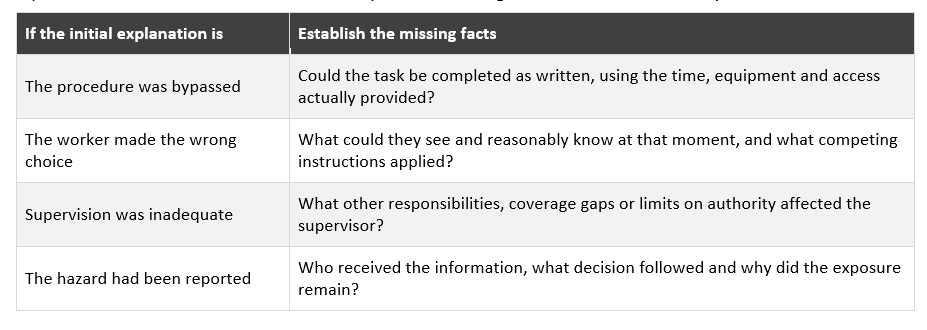
Consider an illustrative maintenance incident initially attributed to an isolation error. The investigation should establish the actual energy sources, condition and identification of isolation points, task changes and coordination arrangements. If labels were ambiguous, retraining alone leaves that ambiguity in place. If the method was impracticable, reissuing it leaves the same conflict for the next worker.
Match actions to supported findings
Separate established facts from hypotheses. Explain how each contributing condition is supported by evidence and what remains uncertain. Avoid claiming that a management weakness caused the event simply because it was discovered during the investigation.
For each supported finding, identify an action that changes the relevant exposure or decision process, its accountable owner and the evidence needed to assess its effectiveness. Consult affected workers about whether the proposed change is workable. Review related tasks or locations where the same condition may exist.
ISO 45001 includes incident investigation and continual improvement within the management system.24 Executive review should therefore examine the reasoning between findings and actions. A long action list can still miss the conditions that mattered.
Before accepting the report, ask whether the proposed changes would have altered the situation faced by the people involved. If management cannot explain that connection, the investigation needs more work before it can support a defensible prevention decision.
Final Word
For the next executive meeting, choose one decision from this edition that sits within your authority. Bring the operational owner and the workers who understand its consequences into the discussion. Establish what needs to change, who can authorise it and what evidence will show whether it helped. Where uncertainty remains, record it and decide how it will be resolved. That creates a useful record of judgement for the people doing the work now and for anyone examining the organisation’s decisions later.
Niru Tyagi | WHS Guard
References
1. PsychLab: https://psychlab.co/
2. Queensland Government. Work Health and Safety Regulation 2011 (Qld), current compilation, particularly ss 34-38 and 55C-55D.
https://www.legislation.qld.gov.au/view/whole/html/inforce/2026-03-29/sl-2011-0240
3. Workplace Health and Safety Queensland. (n.d.). Poor organisational change management. https://www.worksafe.qld.gov.au/safety-and-prevention/mental-health/Psychosocial-hazards/poor-organisational-change-management
4. International Organization for Standardization. (2021). ISO 45003:2021 Occupational health and safety management: Psychological health and safety at work: Guidelines for managing psychosocial risks. Standard overview.
https://www.iso.org/standard/64283.html
5. Safe Work Australia. (2026, September 29). New guide to managing the risks of slips, trips and falls. https://www.safeworkaustralia.gov.au/media-centre/news/new-guide-managing-risks-slips-trips-and-falls
6. Safe Work Australia. (2026, September). Guide to managing the risks of slips, trips and falls, particularly pp. 4-8 and 20-22. https://www.safeworkaustralia.gov.au/doc/guide-managing-risks-slips-trips-and-falls
7. WorkSafe Victoria. (2026, September 24). $150,000 fine after student’s fingers severed by guillotine.https://www.worksafe.vic.gov.au/news/2026-09/150000-fine-after-students-fingers-severed-guillotine
8. WorkSafe Victoria. (2026, September 3). Department store and robotics supplier charged after warehouse fatality.
Available at: https://www.worksafe.vic.gov.au/news/2026-09/department-store-and-robotics-supplier-charged-after-warehouse-fatality
9. Safe Work Australia. (2026, August 5). Taking action to reduce workers’ compensation stigma.
10. Casey, T. W., Hu, X., Lee, Q. Y., & Carden, C. (2021). Stigma towards injured or ill workers: Research on the causes and impact of stigma in workplaces, and approaches to creating positive workplace cultures that support return to work. Griffith University, commissioned by Safe Work Australia. https://www.safeworkaustralia.gov.au/doc/research-causes-and-impact-stigma-workplaces-and-approaches-creating-positive-workplace
11. Safe Work Australia. (2023, April 26). Alex and Lee’s story: Workers’ compensation stigma case study. https://www.safeworkaustralia.gov.au/doc/alex-and-lees-story-workers-compensation-stigma-case-study
12. International Labour Organization. (2026, August 14). Nepal strengthens action on chemical safety with worker protection at its core. https://www.ilo.org/resource/news/nepal-strengthens-action-chemical-safety-worker-protection-its-core
13. United Nations Environment Programme. (2023). Global Framework on Chemicals: For a planet free of harm from chemicals and waste. https://www.unep.org/resources/global-framework-chemicals-planet-free-harm-chemicals-and-waste
14. Safe Work Australia. (2023, June). Model Code of Practice: Managing risks of hazardous chemicals in the workplace, particularly chapters 2-4. https://www.safeworkaustralia.gov.au/sites/default/files/2023-06/model_code_of_practice_managing_the_risks_of_hazardous_chemicals_in_the_workplace.pdf
15. Safe Work Australia. (2026, September 22). 2026 Australian Worker Exposure Survey findings released.
16. Safe Work Australia. (2026, September). 2026 Australian Worker Exposure Survey: Analytical report. Prepared by the Social Research Centre. See methodology and sample design. https://data.safeworkaustralia.gov.au/sites/default/files/2026-09/2026awes_analytical_report_sept26.pdf
17. Safe Work Australia. (2026). Insights from the Australian Worker Exposure Survey 2026. https://data.safeworkaustralia.gov.au/reports/hazards-and-injuries/insights-australian-worker-exposure-survey-2026
18. National Cyber Security Centre (United Kingdom), Australian Signals Directorate’s Australian Cyber Security Centre, & international partner agencies. (2026, January 15). Secure connectivity principles for Operational Technology (OT).
19. Australian Signals Directorate, Australian Cyber Security Centre, & international partner agencies. (2024, October). Principles of operational technology cyber security. https://www.cyber.gov.au/business-government/secure-design/operational-technology-environments/principles-of-operational-technology-cyber-security
20. Cybersecurity and Infrastructure Security Agency, Australian Signals Directorate’s Australian Cyber Security Centre, & international partner agencies. (2025, August 14). Foundations for OT cybersecurity: Asset inventory guidance for owners and operators. https://www.cyber.gov.au/business-government/secure-design/operational-technology-environments/foundations-for-ot-cybersecurity-asset-inventory-guidance-for-owners-and-operators
21. Workplace Health and Safety Queensland. (n.d.). Tips for investigating workplace incidents. https://www.worksafe.qld.gov.au/__data/assets/pdf_file/0015/22902/tips-for-investigating-workplace-incidents.pdf
22. Health and Safety Executive. (2004). Investigating accidents and incidents: A workbook for employers, unions, safety representatives and safety professionals (HSG245).https://www.hse.gov.uk/pubns/books/hsg245.htm
23. Workplace Health and Safety Queensland. (n.d.). Notify Workplace Health and Safety Queensland or the Electrical Safety Office. https://www.worksafe.qld.gov.au/safety-and-prevention/incidents-and-notifications/notify-us-of-an-incident/notify-workplace-health-and-safety-queensland-or-electrical-safety-office
24. International Organization for Standardization. (2018). ISO 45001:2018 Occupational health and safety management systems: Requirements with guidance for use. Standard overview.