

Contents
WHS Guard Newsletter: March 2026. 1
Section 1: Niru’s Editorial Insight, Fatigue a Governance Problem.. 1
Section 2: Queensland Regulator Update – Silica Controls and License Integrity. 2
Section 3: WHS Prosecution Watch – Enforcement Is Testing Systems. 3
Section 4: Industry Voices – Jo Kitney on Practical Safety Systems. 3
Section 5: WHS in South Asia and Oceania. New Zealand’s Reform Debate. 4
Section 6: WHS Research, Wearable Exoskeletons; What the Evidence Supports and What It Does Not. 4
Section 8: Capability Focus Evidence of Due Diligence –. 6
Section 1: Niru’s Editorial Insight, Fatigue a Governance Problem
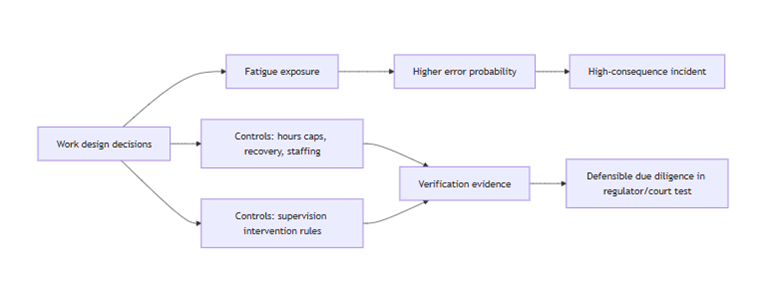
Fatigue is not a vibe, a mindset, or a resilience gap. It is a predictable failure mode created by the way work is designed and managed. If leadership still treats fatigue as “people should manage themselves,” the organization is outsourcing safety to biology and biology does not negotiate. Hours of work, shift patterns, short turnarounds, unplanned overtime, workload peaks, staffing gaps, long commutes, and interactive pressure (production targets plus time scarcity) all shape fatigue exposure. When fatigue is filed under “wellbeing,” it becomes invisible in the risk register and unmanaged in operations.
A roster that looks legal on paper can still be unsafe in practice once you add travel, second jobs, caregiving, call‑backs, peak season surge, and the reality that “finish times” slide. That is why fatigue shows up in the moments that matter vehicle drift and near misses, wrong isolation points, dropped loads, medication errors, procedural shortcuts, and reduced situational awareness around moving plant. Most businesses only notice fatigue after the first near.
The legal framing matters. That pushes leaders away from posters and toward controls that change exposure: staffing models, roster design rules, caps on hours, protected recovery time, task rotation, safe travel and accommodation decisions, and supervisors trained to intervene. Once a practical code of practice exists, “reasonable” is no longer whatever your business says it is; you will be compared to a published yardstick.
Here is an executive test of maturity is not “we have a fatigue policy,” but evidence that fatigue risk was identified, assessed, and controlled at the work‑design stage. The business changed the plan when fatigue rose. If a serious incident occurs, the question will not be “did you mean well?” It will be “what did you do, when you knew fatigue was foreseeable?” Fatigue is where cheap productivity gains go to die publicly. Treat it like any other high‑consequence hazard: define it, engineer controls, verify performance, and keep proof.
References
Model Code of Practice: Managing the risk of fatigue at work. Safe Work Australia.
International Organization for Standardization
Section 2: Queensland Regulator Update – Silica Controls and License Integrity
Queensland’s enforcement posture is increasingly consistent across “high-harm” hazards: regulators are signalling that it is no longer enough to have policies, intentions, or generic plans. Duty holders are expected to demonstrate, quickly and credibly, that critical controls are in place, working, and actively verified, and that worker competence (especially where a licence is a safety-critical barrier) is authentic, current, and verified at the point of use.
Two March 2026 relevant signals illustrate this pattern.
First, respirable crystalline silica is being regulated as a control-assurance problem: processing of crystalline silica substances must be “controlled,” high-risk processing is tied to a documented silica risk control plan (or an equivalent SWMS) with explicit implementation and stop-work consequences when reality diverges from the plan.
Second, high-risk work licensing is being treated as system integrity: the regulator is explicitly warning that forged/altered licence evidence is circulating, including AI-assisted document manipulation, and is linking this to police referrals and charges. A licence can only function as a control if businesses treat verification as part of their safety management system not as an administrative checkbox.
References:
WorkSafe Queensland (2024). Regulation on processing crystalline silica substances.
WorkSafe Queensland. (2024). Ban on engineered stone: Protecting workers’ health. WorkSafe Queensland.
Safe Work Australia. (2025). Model Code of Practice: Managing risks of respirable crystalline silica in the workplace. Safe Work Australia. [9]
WorkSafe Queensland. (2026). High-risk work licenses fraud alert. WorkSafe Queensland.
Section 3: WHS Prosecution Watch – Enforcement Is Testing Systems
Prosecutions are not about “bad luck.” They are a forensic audit of your system: what was foreseeable, what controls existed, what you implemented, and what you failed to verify. Three matters from late 2025 are worth reading as signals, not anecdotes.
Commonwealth psychosocial conviction. In December 2025, the Department of Defense was convicted and fined after pleading guilty to failing to manage psychosocial risks relating to the death of a worker by suicide while on duty. The regulator described the outcome as the first time a Commonwealth employer had been convicted for failing to manage psychosocial risks under federal WHS laws, and the court also made an adverse publicity order. Critically, the alleged control failure was not “we didn’t have a policy.” It was capability and application: supervisor training and the use of a performance management “work plan” process that was treated as a foreseeable psychosocial hazard requiring controls.
Fatigue‑linked transport fatality. In September 2025, a Victorian warehousing and logistics company and its director were convicted and fined a total of $1.43 million after a fatigued delivery driver died in a crash. The company received a seven‑figure fine for reckless endangerment alongside other penalties, and the director was fined personally. The message is direct: if your scheduling and delivery model generates fatigue, regulators will treat that as a controllable safety risk, not an unfortunate exposure.
Mining maintenance fatality prosecution. In Western Australia, prosecution action commenced against a mining maintenance company after the death of a heavy diesel mechanic during truck axle removal work. The regulator’s summary describes jacking work, adverse conditions (including a deflated tyre causing lean), and catastrophic failure when a jack failed. This is the classic critical‑controls lesson: high‑consequence tasks require engineered redundancy, verified stability, and a system that makes stopping work easy and consequence‑free.
Board takeaway: treat these cases as an audit checklist:
Ask where the risk was created upstream (rostering, performance pressure, work method design), how critical controls were defined, and how competence was verified.
Then look for the weak point that usually breaks first supervision under time pressure.
An organization needs verified fatigue controls, psychosocial controls, and high‑consequence task controls in day‑to‑day work.
References:
Comcare (2025). Defense convicted after RAAF worker’s death.
WorkSafe Victoria (2025). Company and director fined $1.43 million after fatigued driver’s fatal crash.
WorkSafe WA (2025). Mining maintenance company prosecuted over worker death.
Section 4: Industry Voices – Jo Kitney on Practical Safety Systems
I met Jo Kitney at a r safety networking event last year and our conversation quickly turned to a familiar challenge in WHS: why so many organisations have safety systems that exist on paper but struggle in practice. Jo is the Managing Director of Kitney OHS and has spent more than two decades helping organisations across Australia and the United Kingdom translate WHS obligations into systems that actually work.
Jo’s view is straightforward. Compliance alone does not create safe organisations. Policies and procedures matter, but they only become effective when they are embedded into the way work is planned, tracked and reviewed.
She also highlights the growing role of digital tools in safety governance. When risk registers, actions and documentation are properly structured within platforms such as Microsoft 365, leaders gain far clearer visibility of risk and accountability.
In Jo’s words, the goal is simple: safety systems should support work, not sit on a shelf.
https://www.linkedin.com/in/jo-kitney-462075a/
Section 5: WHS in South Asia and Oceania. New Zealand’s Reform Debate
In New Zealand, a Health and Safety at Work Amendment Bill was introduced in February 2026 and framed by government as a way to sharpen the system’s focus on “critical risks” while reducing compliance costs. The reform agenda sits within a broader health and safety reform program, and public reporting shows active debate about whether the changes will improve safety or create confusion about what still must be managed. For duty holders operating across the Tasman, the governance lesson is to keep a consistent baseline aligned to ISO 45001, then map local variations as additions not as permission to reduce controls.
References:
Ministry of Business, Innovation and Employment. (n.d.). Health and safety reform. MBIE.
Government of New Zealand (2026). Milestone health and safety bill passes first reading. The Beehive.
Radio New Zealand (2026). “Confusing”: Proposed health and safety law changes will not make workers safer, experts say. RNZ.
Section 6: WHS Research, Wearable Exoskeletons; What the Evidence Supports and What It Does Not
Wearable occupational exoskeletons are increasingly promoted as a control for hazardous manual tasks, particularly in industries with high exposure to repetitive lifting, sustained postures, or overhead work. The research base is expanding quickly, but the evidence remains more limited than many product claims suggest. Current studies support a narrow conclusion. Some exoskeleton designs can reduce specific biomechanical loading measures for certain tasks under controlled conditions. What has not yet been demonstrated consistently is a sustained reduction in work-related musculoskeletal disorders across different workplaces, over long periods, and under real operating pressures.
A persistent limitation in the research is the reliance on short-term laboratory trials. Many studies measure muscle activation, trunk angles, perceived exertion, or task speed rather than long-term injury outcomes. From a WHS governance perspective, this matters. A control that performs well in a controlled test may not perform the same way in real work where discomfort, restricted movement, poor fit, heat, and fatigue influence whether workers actually use the device correctly over a full shift. Behavioural adaptation also occurs. When workers feel protected, they may work faster, lift more, or remain longer in awkward postures, changing exposure rather than reducing it.
Risk may also shift rather than disappear. Back-support devices can reduce loading on the spine but increase demand on hips or legs. Upper-limb supports may reduce shoulder strain but limit reach or alter balance. Prolonged wear can introduce heat stress, skin pressure, and fatigue. These secondary effects are often not visible in short trials but become significant in real workplaces.
An evidence-aligned approach is cautious. Exoskeletons should be treated as a supplementary control, not a substitute for good work design. Start with one high-strain task, establish baseline exposure, and define what success means in measurable terms, such as reduced time in awkward posture or reduced peak load. Trial with a small group, include different body sizes and job roles, and monitor usability, adverse effects, and unintended changes in behaviour. Use multiple indicators, including observation, worker feedback, and incident data.
Procurement must also be considered part of risk control. Exoskeletons require fit assessment, maintenance, cleaning, and supervision of correct use. If these cannot be managed consistently, the device may introduce risk rather than reduce it.
Most importantly, the presence of wearable technology does not mean the task is controlled. Risk assessment must still consider workload, pace, duration, recovery time, and supervision. If those factors remain unchanged, the underlying exposure remains.
References:
Cardoso, A., et al. (2024). Evaluating exoskeletons for WMSD prevention: A systematic review of applications and ergonomic approach in occupational settings. (Journal article).
Bhat, S., et al. (2025). Mapping the evidence on occupational exoskeleton use for work-related musculoskeletal disorder reduction: A scoping review. (Journal article).
Brunelli, G., et al. (2025). Review of upper-limb occupational exoskeletons: From technology to assessment. (Journal article).
Botti, L., et al. (2024). Occupational exoskeletons: Understanding the impact on worker health, safety and performance and recommendations for adoption. (Journal article).
Section 7: Emerging WHS Trends, Lithium-Ion Batteries and BESS Are Becoming Workplace Fire and Emergency Risks
Lithium‑ion battery risk is no longer confined to consumer electronics. It sits inside workplaces through tools, e‑mobility, warehouse equipment, and the rapid growth of battery energy storage systems (BESS) in construction and industrial contexts. The hazard profile is high consequence: thermal runaway, toxic smoke, re‑ignition, and difficult suppression. When a lithium incident occurs indoors, near combustible stock, in worker accommodation, or in waste handling, outcomes escalate quickly from device failure to evacuation, emergency response complexity, and potential fatality.
Control themes are converging across regulators, emergency services, and product safety agencies. Product integrity is foundational: reputable products, matched chargers, and avoiding modified, counterfeit, or damaged batteries and devices. Charging discipline is next: charging on non‑flammable surfaces, keeping charging away from exits and high‑fuel areas, avoiding unattended and overnight charging, and isolating damaged units. Storage and disposal complete the control set: segregate batteries from ignition sources and combustibles, quarantine damaged batteries, and dispose of them through approved pathways to prevent waste‑stream fires.
WHS obligations now intersect with emergency planning in a way many organizations have not resourced. Guidance is becoming more operational and enforceable. SafeWork NSW explicitly links serious lithium‑ion battery incidents to immediate incident notification obligations and encourages reporting to enable investigation and prevention. WorkSafe Victoria has issued specific guidance on safe BESS placement on construction sites, including preserving evacuation routes, providing clearance from plant access points, and planning emergency access so responders are not forced into smoke or thermal hazard zones. Queensland’s BESS guidance links battery hazards to the hierarchy of controls and to foundational risk management duties.
For senior leaders, the governance issue is integration. Lithium risk sits across WHS, hazardous chemicals and dangerous goods, electrical safety, procurement, and emergency management. Most organizations have these functions separated; battery risk does not respect that structure. Practical integration means three things: a single charging and storage standard applied across sites, clear ownership for emergency planning (including evacuation, isolation, and first‑response actions), and a decision rule for when an event becomes a notifiable incident and what evidence must be preserved.
This also creates a competency requirement. Supervisors and first responders need battery‑specific cues (swelling, heat, venting, unusual odour), clear shutdown and isolation steps, and realistic drills that assume toxic smoke and rapid escalation.
Importantly, lithium events create a learning challenge. The instinct to “clean up and move on” is strong, especially when no one is injured. But guidance from regulators explicitly links serious lithium battery events to notification duties, and WorkSafe Victoria’s BESS guidance is framed around preventing secondary harm through poor placement and poor emergency access. In short: treat lithium events like other high‑consequence hazards—report, investigate, fix the system, and share learnings before the next event is worse.
The organizations that avoid the headline incident will be those that treat battery hazards as a system problem: procurement controls, charging and storage standards, site layout rules, emergency response planning, competent supervision, and rapid learning from near misses.
References:
SafeWork NSW (2026). Lithium-ion batteries. SafeWork NSW.
Fire and Rescue NSW (2025). Battery and charging safety. FRNSW.
WorkSafe Victoria. (2025). Safe placement of Battery Energy Storage Systems on construction sites.
WorkSafe Queensland. (2023). Battery energy storage systems (BESS).
WorkSafe Queensland. (2025). Reminder: Safe storage lithium-ion battery use.
ACCC Product Safety (2026). Lithium-ion batteries guide.
Section 8: Capability Focus Evidence of Due Diligence –
Most WHS “systems” sound convincing until a regulator asks one question: what did the officers do, when, and how do you know? Under the model WHS laws, officer due diligence is a personal, proactive duty to take reasonable steps to ensure the PCBU complies with WHS duties. It is not met by delegating to a safety manager or approving a policy.
Due diligence requires officers to:
· Keep WHS knowledge current.
· Understand operations and hazards.
· Ensure suitable resources and processes exist and are used.
· Ensure the PCBU has processes to receive,
· Consider and respond to WHS information.
· Ensure compliance processes are implemented.
· Verify that resources and processes are actually operating.
Enforcement rarely turns on intentions. It turns on evidence you can produce under pressure.
Inspectors test the decision trail: how risks were identified, how critical controls were selected, what resourcing decisions were made, and how effectiveness was verified. If your governance record is only lag indicators (injury rates, completion counts) and generic reassurance, you cannot demonstrate active due diligence. In the courtroom, the absence of contemporaneous proof becomes the story: the board did not know, did not ask, or did not act.
Expect questions like show me the verification, what was escalated, which actions were overdue, and where the evidence contractors were checked before work started.
Regulator‑credible evidence is dull and specific. It includes board and committee minutes that record challenge, decisions, and follow‑up. It includes WHS reports that elevate the top critical risks and show control performance, not just injury stats. It includes action registers with owners, due dates, and closure evidence. It includes assurance: audit reports, site verification walks, and critical control checks with findings and corrective actions. It also includes competence and authorization evidence (training records, competence assessments, high risk work license checks, and clear supervision arrangements) and supply chain evidence procurement controls and contractor verification where third parties create or control the risk.
Capability improves fastest when officers standardize what “good evidence” looks like. Put a fixed WHS governance pack on every agenda: top five critical risks; the critical controls for each; leading indicators; overdue actions; serious near misses; and assurance outcomes. Set a cadence (monthly operational verification and quarterly independent assurance) and insist on documented outcomes, including stop‑work decisions and funded redesigns. If these records do not exist, officers cannot prove due diligence, even if the business can point to a safety management system.
https://www.safeworkaustralia.gov.au/system/files/documents/1812/officer-duty-interpretive-guide.pdf
https://www.legislation.qld.gov.au/view/whole/html/inforce/2026-03-13/sl-2011-0240
Final Word
This issue carries one clear message. Predictable harm now means predictable accountability.
Fatigue, exposure controls, emerging technologies, and competence failures are no longer treated as operational problems. They are being tested as governance failures. Regulators and courts are asking a harder question than before. Not whether a system exists, but whether it actually prevented harm.
A fatigue procedure is meaningless if rosters still break recovery limits.
A silica plan is meaningless if controls cannot be verified on the floor.
A charging policy is meaningless if lithium risks are not engineered out of the workplace.
The organisations that stay ahead will be the ones that can show evidence, not intent.
· Evidence of work design changes.
· Evidence of control verification.
· Evidence of competence checks.
· Evidence of intervention when risk increased.
If your board pack cannot demonstrate those things with real examples, your WHS system is still a story. And stories are often rewritten by regulators after the incident.
· Pick one action this month.
· Reality-check one roster.
· Physically verify one critical control.
· Audit one high-energy hazard.
If you find gaps, treat them as system defects. Fix the design, not the person.
Stay sharp. Stay accountable.
Niru Tyagi | WHS Guard (Queensland Edition)