

Section 1: Niru’s Editorial Insight: Working for Queensland Is Not a Psychosocial Risk Assessment
Section 2: Regulator Update: New Workplace Exposure Limits, The Chemical Numbers Are Changing
Section 3: WHS Prosecution Watch: Asbestos, Decommissioning and the Risk of Known Hazards
Section 4: Field Notes: Confidentiality Should Protect People, Not Hide Risk
Section 5: WHS in South Asia and Oceania: Fiji Prepares to Revisit a 30 Year Old Safety Framework
Section 6: WHS Research: Return to Work Is More Than Finding Suitable Duties
Section 7: Emerging WHS Trend: Secondary Psychological Injury Moves Into Regulatory Assurance
Section 8: Practical Tool: Turning WfQ Results Into Psychosocial Risk Assurance
Section 1: Niru’s Editorial Insight
Working for Queensland Is Not a Psychosocial Risk Assessment
Across the Queensland public sector, the Working for Queensland survey opened again on 31 August.
More than 68,000 employees participated in 2025. The Public Sector Commission describes WfQ as a confidential employee survey covering issues such as leadership, team culture, manager support, flexibility and accountability.¹
It is valuable information.
But there is an important distinction that public sector leaders need to make.
Working for Queensland can tell you where to look. It cannot tell you that psychosocial risk has been managed.
That distinction matters because psychosocial risk management is moving quickly from an employee experience issue into a formal WHS governance obligation.
What WfQ actually measures
Since 2022, Working for Queensland has been structured around the Job Demands Resources model. The Queensland Government describes that model as a framework for understanding factors contributing to employee engagement.²
There is substantial overlap with psychosocial risk.
The survey contains useful intelligence about autonomy, role clarity, workload, burnout, emotional exhaustion, manager support, fairness, psychological safety, bullying, sexual harassment, violence and aggression.
That information should absolutely be used by WHS leaders.
But overlap is not equivalence.
Queensland’s WHS Regulation requires a PCBU managing psychosocial risks to consider the duration, frequency and severity of exposure, how hazards interact or combine, the design of work, the systems through which work is managed and supported, workplace conditions, behaviours, and the information, training and supervision provided to workers.³
That requires much more than a survey score.
Imagine an agency receives a poor result for workload.
The percentage tells you something.
It does not necessarily tell you whether the exposure comes from vacancies, excessive caseloads, approval bottlenecks, unrealistic deadlines, poor technology, repeated restructures, conflicting executive priorities or insufficient decision authority.
Those distinctions matter because the control will be different in each case.
A workload problem created by vacancies requires a different response from one created by unnecessary approvals.
A role clarity problem created by poor position descriptions requires a different response from one created by constant organisational change.
A manager support problem may actually be the consequence of managers carrying impossible spans of control themselves.
The survey identifies a signal. Risk management has to explain the mechanism.
Aggregation can hide the risk that matters most
There is another problem with organisation-wide surveys.
A reasonable agency result can coexist with a very unhealthy team.
In 2024, WfQ received 71,853 responses, representing a 45 per cent response rate.² A response rate of that size does not make the data unhelpful, but neither does a large number of responses remove the possibility of non-response or localised risk.
Small teams may disappear inside agency averages.
High-risk occupational groups can disappear inside function-level reporting.
Privacy suppression can make very small groups difficult to analyse.
And the people experiencing the greatest distrust may not necessarily be the people most willing to complete a workplace survey.
That last issue deserves particular attention.
The Public Sector Commission reported that its 2025 post-survey evaluation found the largest barrier to participation was concern among employees that the survey was not confidential.¹
The Commission has strongly reiterated the confidentiality protections applying to WfQ.
The governance implication is not that the survey cannot be trusted. It is that organisations should be careful about treating participation numbers as proof that every workforce group has been heard.
Where results suggest concern about trust, fairness, reporting or leadership, leaders may need additional consultation mechanisms.
A survey is one form of consultation
Queensland’s psychosocial Code is clear that surveys can be used to identify psychosocial hazards.
But surveys sit alongside worker discussions, observations of how work is performed, examination of incidents and complaints, workplace inspections, workers’ compensation information and consultation with workers and HSRs.⁴
The Code also makes clear that consultation should continue throughout risk identification, assessment, control selection and review.
That is important.
A survey asking workers what they experience is not the same thing as workers participating in the redesign of the work creating the exposure.
Psychological safety is not psychosocial safety
WfQ also measures psychological safety.
That is useful, but the language can create confusion.
Psychological safety generally concerns whether people believe they can speak, contribute, question or make mistakes without inappropriate interpersonal consequences.
Psychosocial risk management asks a broader question.
How is work exposing people to the risk of psychological or physical harm, and what has the organisation changed to reduce that exposure?
A team can feel relatively comfortable speaking to each other while still carrying unreasonable workloads.
A highly collegial team can still be chronically understaffed.
A supportive manager cannot necessarily compensate for an operating model that generates excessive emotional demands.
Psychological safety is an organisational resource.
It is not evidence that psychosocial hazards are controlled.
The real risk comes after the survey
This is where I think organisations need to pay much closer attention.
The mistake starts when WfQ results become an employee engagement plan rather than risk intelligence.
A workload result becomes a wellbeing workshop.
Poor manager support becomes leadership training.
Stress becomes an EAP communication campaign.
Low morale becomes a culture initiative.
Those actions may have value.
But if the hazard comes from the design of work, the primary control needs to change the design of work.
That may mean staffing.
Priorities.
Caseload allocation.
Decision authority.
Shift arrangements.
Service expectations.
Escalation pathways.
Change processes.
Manager spans of control.
Or how performance targets are designed.
The Queensland Code requires organisations to move through hazard identification, risk assessment, control and review.⁴
A workforce survey can contribute evidence to that process. It cannot replace it.
Is HR equipped to manage what comes next?
HR absolutely belongs at the table.
In fact, HR often sees psychosocial risk before the formal WHS system does.
Grievances, absenteeism, turnover, performance matters, flexible-work disputes, complaints, recruitment difficulties, return-to-work cases and organisational change can all be early indicators of work-related risk.
The problem is assuming that because HR owns workforce data, HR also owns psychosocial risk.
It does not.
Australian HR Institute research has found psychosocial risk rising across Australian workplaces while investment in management capability remains uneven. In its 2025 research, only 28 per cent of responding employers reported investing in leadership and management capability specifically to improve psychosocial health.⁵
That is not evidence that HR professionals are incapable.
It is evidence that organisational capability cannot be assumed.
Psychosocial risk management requires knowledge of hazard identification, exposure assessment, work design, control selection, consultation, incident data, reasonably practicable controls, control verification and WHS governance.
It also requires detailed knowledge of operations.
HR cannot redesign service delivery alone.
WHS cannot determine staffing alone.
A manager cannot solve enterprise resourcing alone.
That is why the stronger model is shared.
HR holds critical workforce intelligence.
WHS provides risk methodology and assurance.
Operational leaders own the design and management of work.
Workers and HSRs explain how that work actually operates.
Executives allocate resources and resolve systemic constraints.
Officers verify that the system is working.
HR should absolutely be at the table. It should not be sitting there alone.
And this year there is another useful signal.
Workplace Health and Safety Queensland is decommissioning the People at Work platform because changes in legislation, new tools and updated research mean the survey may no longer fully meet organisations’ needs. Queensland now directs employers to its psychosocial risk assessment tool aligned with the 14 hazards in the Queensland Code.⁶
That should make organisations think carefully.
If a validated survey designed specifically for psychosocial risk has needed to evolve as the regulatory environment changed, it is difficult to argue that a general employee experience survey can carry the entire psychosocial risk management process.
WfQ is not the problem.
False assurance is.
The question for leaders when the results arrive is therefore not simply:
What did our score do?
It is:
Now that workers have told us where the problems may be, what are we going to do to understand and control the risk?
Section 2: Regulator Update
New Workplace Exposure Limits: The Chemical Numbers Are Changing
On 1 December 2026, one of the largest changes to Australia’s airborne contaminant framework in decades takes effect.
The existing Workplace Exposure Standards for Airborne Contaminants will become Workplace Exposure Limits.
The terminology is deliberate.
Safe Work Australia says the change from “standards” to “limits” is intended to reinforce that these are concentrations that must not be exceeded. More than 600 substances and mixtures have an established WES or WEL, and a number of individual limits and listings will change when the new framework commences.⁷
For Queensland businesses, WHSQ has confirmed the new limits take effect from 1 December 2026. The underlying duty to eliminate or minimise exposure to airborne contaminants remains unchanged.⁸
This should not be treated as an SDS update exercise.
What is actually changing?
Some exposure limits will decrease.
Some increase.
Some contaminants have been added, removed, merged or split.
New advisory notation arrangements include separate dermal and respiratory sensitisation notations, DSEN and RSEN, and a new OTO notation for substances capable of contributing to hearing loss.⁹
The OTO change is especially interesting from a systems perspective.
It means some chemical exposure assessments will need to be considered alongside noise exposure rather than in an occupational hygiene silo.
One particularly significant new limit applies to diesel particulate matter.
From 1 December, the WEL for diesel particulate matter will be 0.01 mg/m³.
Safe Work Australia has specifically identified mining, quarrying, tunnelling, construction, agriculture, transport and logistics, oil and gas, and vehicle maintenance as environments where diesel engine emission exposure may occur.¹⁰
That creates immediate questions about underground and enclosed work, workshops, loading areas, maintenance facilities and businesses operating older diesel fleets.
Thirty-three carcinogens will no longer have a numeric limit
The transition also changes the treatment of 33 non-threshold genotoxic carcinogens.
Safe Work Australia says a practical protective exposure threshold cannot be assigned to these substances because of their nature and the available evidence.
From 1 December, they will therefore no longer have numerical exposure limits.
They include substances such as chromium VI compounds, ethylene oxide, 1,3-butadiene and vinyl chloride.⁹
The absence of a number does not mean absence of a duty.
It means the opposite.
PCBUs must eliminate these contaminants where reasonably practicable, replace them with safer alternatives where possible, or minimise the risk so far as is reasonably practicable.
That is a major governance point.
Organisations accustomed to asking whether a monitoring result is “under the limit” will need a different conversation for substances where no safe numeric threshold is being applied.
Not every proposed limit is changing
There is also an important qualification.
Nine substances received additional regulatory impact analysis: benzene, chlorine, copper, formaldehyde, hydrogen cyanide, hydrogen sulphide, nitrogen dioxide, respirable crystalline silica and titanium dioxide.
In June, Safe Work Australia advised that a majority of WHS ministers had not supported changing those nine exposure levels at this stage.
Their current limits will therefore remain when the WEL framework begins on 1 December.¹¹
This is precisely why businesses should not rely on old spreadsheets, generic chemical registers or assumptions about what changed.
The organisational mechanism behind the risk
The biggest failure I expect during this transition is simple.
Someone in WHS updates the chemical register.
Someone in procurement asks suppliers for new SDS.
And everyone assumes the job is complete.
It is not.
Airborne contaminant risk is created through work.
Grinding generates dust.
Diesel engines generate particulate.
Welding generates fumes.
Cleaning, spraying, mixing, cutting, heating and maintenance can all create exposures that do not arrive neatly labelled in a container.
The real transition therefore sits in work processes, ventilation, isolation, substitution, maintenance, air monitoring, health monitoring, contractor management and supervision.
Safe Work Australia released new air monitoring and diesel engine emissions guidance on 30 July and launched an updated Hazardous Chemical Information System on 4 August to support the transition.¹⁰ ¹²
What leaders should expect before 1 December
By November, I would expect a mature organisation to be able to show:
a mapped inventory of substances used and generated through work;
a comparison between relevant current WES and incoming WEL values;
identification of substances with changed limits or notations;
specific review of diesel particulate exposure where relevant;
identification of non-threshold genotoxic carcinogens;
updated exposure assessments;
air monitoring where uncertainty remains;
evidence that ventilation and other engineering controls have been tested;
revised operating procedures and worker information where controls change;
contractor and procurement requirements reflecting the new limits, and
a documented management review confirming readiness.
The date is 1 December.
But the governance deadline is earlier.
If an organisation waits until December to discover that an existing ventilation system cannot consistently maintain exposure below a new limit, the failure did not occur on 1 December.
It occurred during the transition period when nobody checked.
Section 3: WHS Prosecution Watch
Asbestos, Decommissioning and the Risk of Known Hazards
A South Australian prosecution in August provides a useful lesson about an often-neglected stage of organisational life: shutting things down.
On 13 August 2026, Conroy’s Smallgoods Pty Ltd was convicted and fined $90,000 after pleading guilty to a Category 3 offence involving asbestos risks during clean-up and demolition works at its former Brompton food-processing facility.¹³
SafeWork SA reported that the company was aware asbestos-containing material was present.
Workers nevertheless undertook clean-up and demolition activities between December 2021 and February 2023.
An asbestos assessment later found friable and non-friable asbestos had been disturbed, with debris throughout the workplace and on adjoining property. The company had also undertaken asbestos removal without the required licence and had not established appropriate removal work areas, airborne fibre monitoring or independent clearance inspections.¹³
The court described the breach as egregious.
The governance lesson is bigger than asbestos
The obvious lesson is to manage asbestos correctly.
The more useful lesson is about non-routine work.
Many organisations have mature controls for normal operations but much weaker governance around:
closure;
decommissioning;
renovation;
relocation;
demolition;
major maintenance, and
site handover.
These activities are often treated as temporary projects.
Normal operating teams leave.
Contractors arrive.
Asset information is incomplete.
Budgets tighten because the site is no longer revenue-producing.
The organisation mentally moves on before the physical risk has disappeared.
That is exactly when legacy hazards become dangerous.
Board question
When an asset, building or operation is being closed, who becomes the owner of the residual WHS risk?
The evidence I would expect includes an asbestos and hazardous-material review before intrusive work begins, contractor licensing verification, defined work boundaries, air-monitoring requirements, clearance evidence, and formal transfer of accountability between operations, property, project and contractor teams.
Decommissioning is not the absence of operations.
It is a different operation with a different risk profile.
Section 4: Field Notes
Confidentiality Should Protect People, Not Hide Risk
There is a recurring problem in psychosocial risk governance that receives surprisingly little attention.
HR may know about six complaints in the same division.
The workers’ compensation team may know about two psychological injury claims.
A manager may know three people have requested transfers.
WHS may see none of it.
Not because anyone is deliberately hiding information.
Because each matter is confidential.
Confidentiality is essential.
But confidentiality and organisational blindness are not the same thing.
The organisation does not necessarily need the names, personal details or allegations to know that several indicators are appearing in the same workgroup.
This is where the interface between HR and WHS becomes a control.
Individual cases need privacy.
Systemic risk needs visibility.
A mature organisation should be able to convert sensitive people information into de-identified risk intelligence.
For example:
six unrelated grievances in one team;
rapid turnover after a restructure;
repeated stress-related absence;
multiple complaints about workload;
several performance matters involving the same role design, or
return-to-work cases repeatedly breaking down under the same manager.
Any one case may be private.
The pattern is an organisational risk signal.
Queensland’s psychosocial Code specifically directs PCBUs to use reports, records, worker consultation, observations and surveys when identifying psychosocial hazards.⁴
The governance challenge is therefore designing an information system that protects individual privacy while allowing patterns to reach the people who own the risk.
This is where HR needs clear escalation criteria.
Not every complaint belongs on a WHS dashboard.
But repeated exposure indicators should not disappear because no single case crosses a reporting threshold.
A useful test is:
Can your organisation identify a pattern without identifying the person?
If the answer is no, the organisation may have a privacy process.
It does not yet have a psychosocial risk intelligence process.
Section 5: WHS in South Asia and Oceania
Fiji Prepares to Revisit a 30 Year Old Safety Framework
Fiji is worth watching this month.
The Fiji Commerce and Employers Federation reported in July that the Government has indicated the Health and Safety at Work Act 1996 is due for review. The Federation says modernisation of the legislation is on its 2026–27 work program, with consultation expected through Fiji’s tripartite National Occupational Safety and Health Advisory Board.¹⁴
The existing Act dates from 1996 and established broad employer duties, safety committees, inspection arrangements and the National Occupational Health and Safety Advisory Board.¹⁵
Fiji has amended parts of its safety framework over time, including workplace-condition regulations, but the principal Act is now approaching three decades old.
That matters because the work it governs has changed substantially.
Digital technology has changed.
Tourism has changed.
Construction has expanded.
Climate exposure has changed.
Supply chains have changed.
Workforce mobility has changed.
And international expectations around psychological health, worker participation, occupational hygiene and due diligence have moved considerably.
The Australian governance lesson
The lesson is not that older legislation automatically creates unsafe workplaces.
Good organisations frequently operate above minimum legal requirements.
The lesson is that businesses should not wait for regulation to tell them what modern risk management looks like.
Australian companies operating in Fiji, purchasing from Fiji or using regional contractors should maintain a consistent enterprise risk standard rather than allowing local legal minimums to define the quality of controls.
ISO 45001 provides one useful mechanism for doing this because it allows organisations to maintain a common health and safety management architecture while mapping jurisdiction-specific legal requirements underneath it.
That approach also protects organisations from a familiar transition problem.
When local legislation changes, the business is not starting from zero.
Its systems are already designed around risk, consultation, competence, assurance and continual improvement.
Board question
For businesses operating across the Pacific:
Are your overseas safety standards based on what the local law currently allows, or on what your organisation already knows good risk management requires?
Section 6: WHS Research
Return to Work Is More Than Finding Suitable Duties
Safe Work Australia’s 2025 National Return to Work Survey deserves more attention from WHS leaders.
The national return-to-work rate declined from 91.6 per cent in 2021 to 88.9 per cent in 2025.
Workers with physical injuries had a return-to-work rate of 90.2 per cent.
For workers with psychological injuries, it was 76.5 per cent.¹⁶
Those figures tell us there is a problem.
They do not, by themselves, prove what causes it.
That distinction matters.
Return to work is influenced by injury severity, occupation, labour-market conditions, healthcare, worker circumstances, insurer practices, workplace relationships and many other factors.
The survey does, however, identify organisational features associated with better outcomes.
Workers who reported having a return-to-work plan had a return rate of 94 per cent compared with 81.7 per cent among those without one.
Safe Work Australia also found better reported outcomes where employers helped workers manage their injury or illness before a compensation claim was lodged.¹⁶
These are associations, not experimental evidence that a plan or early employer contact causes recovery.
But the pattern is still operationally important.
The hidden mechanism is uncertainty
Traditional return-to-work systems tend to focus heavily on medical restrictions.
Can the person lift five kilograms?
Can they work four hours?
Can they drive?
Can they sit?
Those questions matter.
But the experience of return to work also involves control, fairness, role clarity, communication and trust.
A worker can technically have “suitable duties” while experiencing:
no clarity about how long the arrangement will last;
fear about their employment;
uncertain income;
poor communication;
a manager who avoids difficult conversations;
colleagues who do not understand changed duties;
repeated requests to explain the injury, or
a claims process they do not understand.
For someone recovering from a physical injury, these conditions can create a second layer of risk.
For someone recovering from psychological injury, they may reproduce the original hazard.
Return to work is work design
That changes how organisations should think about rehabilitation.
A return-to-work plan should not simply allocate reduced tasks.
It should design a temporary system of work.
That means deciding:
what demands are safe;
what decisions the worker controls;
what information they need;
who will supervise;
how workload will be adjusted;
how colleagues will be briefed while respecting privacy;
what happens if symptoms increase, and
when the controls will be reviewed.
The strongest finding from the survey is therefore not a particular percentage.
It is that return to work cannot be outsourced to a form, an insurer or a rehabilitation coordinator.
The workplace itself remains part of the recovery environment.
What the research does not prove
The data do not mean every worker without a formal plan will have a poor outcome.
They do not prove employer contact is always beneficial.
Poorly managed contact can increase stress.
Nor do they mean psychological injury is simply a more difficult version of physical injury.
Psychological injuries often arise from complex interactions between work design, relationships, management action and individual circumstances.
The governance implication is narrower and more useful.
Organisations should treat return-to-work quality as a control effectiveness issue, not simply a claims metric.
Section 7: Emerging WHS Trend
Secondary Psychological Injury Moves Into Regulatory Assurance
Queensland’s workers’ compensation regulator has made that point even sharper.
Workers’ Compensation Regulatory Services commenced targeted audits across Queensland insurers in July 2026 focused specifically on preventing and managing secondary psychological injuries.¹⁷
The data explain why.
Queensland scheme data indicate 5.1 per cent of workers with a physical injury requiring time away from work later develop an accepted secondary psychological injury.
WCRS says that rate has doubled over five years.
Affected workers spend an average of 303 days away from work and the average claim costs $130,785.¹⁷
Again, cost is not the most important part of the story.
The significant shift is regulatory.
The claims and rehabilitation process is increasingly being treated as something capable of either reducing or amplifying harm.
An organisation can injure someone twice
A worker suffers a physical injury.
What happens next?
The worker may lose income certainty.
Their team stops contacting them because managers are unsure what they can say.
They receive multiple requests for medical information.
They do not understand the claims process.
Suitable duties change repeatedly.
They feel disbelieved.
Their role is quietly redistributed.
They start wondering whether there is still a job to return to.
None of these experiences automatically creates psychological injury.
But together they illustrate why the system following the original injury deserves risk-management attention.
WCRS identifies uncertainty and lack of control, financial stress, pre-injury psychological health and the mechanism of injury among important drivers of secondary psychological injury.¹⁷
This is not just an insurer issue
The formal audit targets insurers because they carry specific statutory obligations.
Employers should still pay attention.
Many of the interactions experienced by injured workers are controlled by employers.
Manager contact.
Suitable duties.
Workplace communication.
Role security.
Workload on return.
Team behaviour.
Escalation when recovery stalls.
The organisation therefore influences the environment in which rehabilitation occurs.
What leaders should ask
Do managers know how to maintain appropriate contact with an injured worker?
Are workers told clearly what will happen next?
Is suitable work genuinely suitable, or merely available?
Are rehabilitation plans designed with the worker?
Does HR identify signs that a physical claim is becoming psychologically complex?
Are insurer delays or communication failures escalated?
And do executives ever see data on failed returns to work, recurrence or secondary psychological injury?
This is where injury management begins to look less like administration and more like organisational design.
That is a useful shift.
Section 8: Practical Tool
Turning WfQ Results Into Psychosocial Risk Assurance
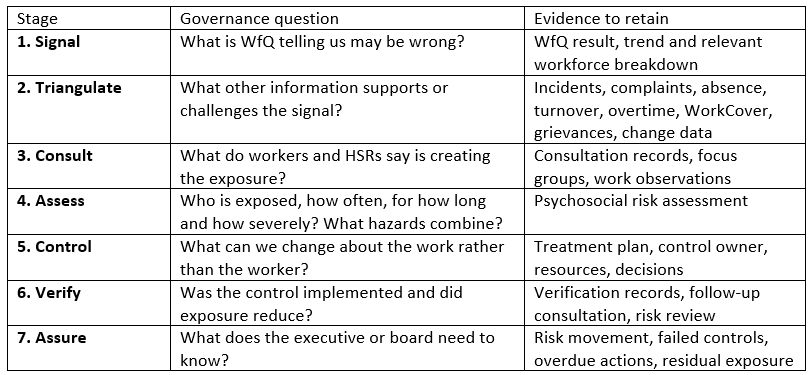
The most useful thing an organisation can do with WfQ results is resist the urge to jump immediately to an action plan.
First convert the result into a risk question.
An example
Suppose WfQ identifies high workload.
The weak response is:
Action: conduct a time-management workshop.
The stronger response asks why workload is excessive.
Analysis finds:
two long-term vacancies;
repeated urgent ministerial requests;
duplicate approvals;
high rework caused by an outdated system, and
managers routinely working after hours.
Worker consultation confirms the same pattern.
Now the organisation can identify controls that actually change exposure.
Prioritisation rules.
Temporary resourcing.
Removal of an unnecessary approval step.
System remediation.
Clear escalation for work that cannot be completed within available capacity.
Limits on routine after-hours communication.
The control question then becomes measurable.
Did overtime reduce?
Did backlog reduce?
Were vacancies filled?
Did after-hours work decline?
Do workers report improved control over workload?
That is risk management.
Five questions for boards and executive teams
When WfQ results reach the executive table, I would ask:
1. Which findings represent potential WHS hazards rather than engagement issues alone?
2. Where could organisation-wide averages be concealing local exposure?
3. What other evidence has been used to validate the findings?
4. What has actually changed in the design or management of work?
5. What evidence tells us those changes reduced exposure?
If the answer to the final question is another survey score, keep asking.
A better score is useful evidence.
It is not, by itself, proof that a control is effective.
Final Word
This month’s theme is simple: organisations already have more WHS information than ever. The real challenge is what they do with it.
Surveys, claims data, exposure monitoring, incident systems and regulator guidance all create organisational knowledge. But knowledge only matters when it changes decisions.
A mature WHS system creates a clear path from:
information to risk;
risk to control;
control to verification, and
verification to assurance.
The question leaders should keep asking is:
What changed because you knew?
That is where stronger WHS governance is heading. Not more activity, but better organisational judgement.
Stay evidence-driven. Stay accountable.
Niru Tyagi | WHS Guard
References
Section 1: Niru’s Editorial Insight
Working for Queensland Is Not a Psychosocial Risk Assessment
Queensland Public Sector Commission. (2026). Working for Queensland survey 2026. Official PSC announcement confirming the 31 August 2026 opening, 2025 participation and confidentiality concerns identified through post-survey evaluation.
Working for Queensland 2026 announcementQueensland Government. (2024). Working for Queensland Survey: Highlights Report, Queensland Public Sector. This is the key source for the Job Demands Resources framework and the detailed WfQ measures.
2024 Working for Queensland Highlights ReportQueensland Government. (2026). Work Health and Safety Regulation 2011, particularly s 55D, Determining control measures for psychosocial risks.
Current Work Health and Safety Regulation 2011Workplace Health and Safety Queensland. (2022). Managing the risk of psychosocial hazards at work Code of Practice 2022.
Queensland Psychosocial Hazards Code of PracticeWorkplace Health and Safety Queensland. (2026). People at Work. Includes the 2026 decommissioning timetable and Queensland’s recommendation to use its psychosocial risk assessment tool aligned with the 14 Code hazards.
People at Work decommissioning and alternativesWorkplace Health and Safety Queensland. (2026). Psychosocial risk assessment tool. Queensland Psychosocial Risk Assessment Tool
Australian HR Institute. (2025). Managing and Minimising Psychosocial Risks in Australian Workplaces.
AHRI psychosocial risk research reportInternational Organization for Standardization. (2021). ISO 45003:2021 Occupational health and safety management: Psychological health and safety at work, Guidelines for managing psychosocial risks. ISO 45003:2021
Section 2: Regulator Update
New Workplace Exposure Limits: The Chemical Numbers Are Changing
9. Workplace Health and Safety Queensland. (2025). New workplace exposure limits. Confirms Queensland’s transition to WELs from 1 December 2026 and that the underlying duty to manage airborne contaminants remains unchanged.
WHSQ: New workplace exposure limits10. Safe Work Australia. (2026). Workplace exposure limits for airborne contaminants. Provides the national WEL framework and transition requirements.
Workplace Exposure Limits hub11. Safe Work Australia. (2026). Changes between the WES and WEL. This is the best source for individual limit changes, revised classifications, additions and removals, advisory notations and the treatment of non-threshold genotoxic carcinogens.
Comparison of WES and WEL changes12. Safe Work Australia. (2026). Workplace exposure limits for airborne contaminants: WEL list. Official Workplace Exposure Limits list
13. Safe Work Australia. (2026, 30 July). New guidance on managing workplace exposure to airborne contaminants. Includes the new 0.01 mg/m³ diesel particulate matter WEL and new air-monitoring guidance.
Air monitoring and diesel emissions guidance14. Safe Work Australia. (2026, 24 June). Decision Regulation Impact Statement: Proposed workplace exposure limits for nine chemicals. Confirms that the existing limits for benzene, chlorine, copper, formaldehyde, hydrogen cyanide, hydrogen sulphide, nitrogen dioxide, respirable crystalline silica and titanium dioxide will not change on 1 December 2026. Decision on the nine exposure limits.
15. Safe Work Australia. (2026, 4 August). New Hazardous Chemical Information System now available. New Hazardous Chemical Information System
Section 3: WHS Prosecution Watch
Asbestos, Decommissioning and the Risk of Known Hazards
16. SafeWork SA. (2026, 17 August). Smallgoods company fined $90,000 over asbestos exposure risks: Templeton v Conroy’s Smallgoods Pty Ltd.
SafeWork SA prosecution summary17. SafeWork SA. (2026). Prosecutions and judgments. Provides the enforcement record and sentencing details for the Conroy’s Smallgoods matter.
SafeWork SA prosecutions and judgments18. Workplace Health and Safety Queensland. (2021). How to manage and control asbestos in the workplace Code of Practice 2021. Queensland asbestos Code of Practice
19. Workplace Health and Safety Queensland. Asbestos: Managing workplace risks.
WHSQ asbestos guidance
Section 4: Field Notes
Confidentiality Should Protect People, Not Hide Risk
20. Workplace Health and Safety Queensland. (2022). Managing the risk of psychosocial hazards at work Code of Practice 2022. The Code identifies reports, records, consultation, observation and surveys as sources for identifying psychosocial hazards.
Queensland Psychosocial Hazards Code of Practice21. Queensland Public Sector Commission. (2024). State of the Sector Report 2024. Of particular relevance is the Commission’s approach of using WfQ alongside workforce data, including absenteeism and turnover, rather than treating survey data as a standalone measure.
Queensland State of the Sector Report 202422. Queensland Government. (2024). Working for Queensland Survey: Highlights Report. Includes reporting on bullying, sexual harassment, workplace violence and reporting behaviour.
Working for Queensland detailed results23. Queensland Government. (2009). Information Privacy Act 2009. Relevant to the handling, use, management and disclosure of personal information by Queensland public sector agencies. Current Information Privacy Act 2009
Section 5: WHS in South Asia and Oceania
Fiji Prepares to Revisit a 30 Year Old Safety Framework
24. Fiji Commerce and Employers Federation. (2026, 26 July). Voice of the Private Sector: Influencing Labour Policies. Reports that the Fiji Government has indicated the Health and Safety at Work Act 1996 is due for review and outlines consultation through the national OHS framework.
FCEF: Modernising Fiji’s workplace safety framework25. International Labour Organization. NATLEX. Fiji: Health and Safety at Work Act 1996.
ILO NATLEX: Fiji Health and Safety at Work Act 199626. International Labour Organization. NORMLEX. Occupational Safety and Health Convention No. 155: Fiji. The ILO supervisory record notes the Fiji Government’s advice that the 1996 Act would be reviewed and requests updates on the legislative review. ILO NORMLEX review commentary for Fiji
27. International Labour Organization. NATLEX. Health and Safety at Work (General Workplace Conditions) Regulations 2003, Fiji.
Fiji General Workplace Conditions Regulations28. International Organization for Standardization. (2018). ISO 45001:2018 Occupational health and safety management systems, Requirements with guidance for use. ISO 45001:2018
Section 6: WHS Research
Return to Work Is More Than Finding Suitable Duties
29. Safe Work Australia. (2025). 2025 National Return to Work Survey results.
2025 National Return to Work Survey results30. Safe Work Australia. (2025). Insights from the National Return to Work Survey. This source provides the key comparative figures used in the article, including 88.9 per cent overall return to work, 90.2 per cent for physical injuries, 76.5 per cent for psychological injuries, and the relationship between return-to-work planning and outcomes. National Return to Work Survey insights
31. Safe Work Australia. (2025). National Return to Work Survey Analysis Report.
Full 2025 NRTW Analysis Report32. Deady, M., Arena, A., Sanatkar, S., Gayed, A., Manohar, N., Petrie, K., & Harvey, S. B. (2025). Psychological workplace injury and incapacity: A call for action. Journal of Industrial Relations, 67(2), 386–398. Psychological workplace injury and incapacity: A call for action
Section 7: Emerging WHS Trend
Secondary Psychological Injury Moves Into Regulatory Assurance
33. Workers’ Compensation Regulatory Services Queensland. (2026). Targeted audit: Early intervention to prevent secondary psychological injuries. This is the primary source for the July 2026 audit program, the 5.1 per cent figure, 303 average days away from work and average claim cost of $130,785. WCRS secondary psychological injury audit
34. Queensland Government. Workers’ Compensation and Rehabilitation Act 2003, s 232AC. Requires insurers to take all reasonable steps to minimise the risk of a worker with an accepted physical injury developing a secondary psychiatric or psychological injury.
Workers’ Compensation and Rehabilitation Act, s 232AC35. Workers’ Compensation Regulatory Services Queensland. (2026). Licensing, performance and compliance. Provides further context on the 2026 secondary psychological injury audit campaign.
WCRS licensing, performance and compliance update36. Monash University Healthy Working Lives Research Group. (2026). Research examining pathways to secondary psychological injury.
Monash secondary psychological injury research37. Workplace Health and Safety Queensland. (2025). Prevent a physical injury becoming a psychological injury.
WHSQ secondary psychological injury guidance
Section 8: Practical Tool
Turning WfQ Results Into Psychosocial Risk Assurance
38. Workplace Health and Safety Queensland. (2022). Managing the risk of psychosocial hazards at work Code of Practice 2022.
Queensland Psychosocial Hazards Code of Practice39. Workplace Health and Safety Queensland. (2026). Psychosocial risk assessment tool. The tool expressly uses the sequence of identifying hazards, assessing risk, controlling risk and reviewing control measures, supported throughout by consultation.
Queensland Psychosocial Risk Assessment Tool40. Safe Work Australia. PCBU duties for managing psychosocial risks. Includes duration, frequency and severity of exposure, interacting hazards, work design, systems of work and consultation requirements.
Safe Work Australia psychosocial PCBU duties41. Safe Work Australia. Consultation when managing WHS risks.
Worker and HSR consultation guidance42. International Organization for Standardization. (2021). ISO 45003:2021 Occupational health and safety management: Psychological health and safety at work. ISO 45003:2021