

Content
s
Section 1: Niru’s Editorial Insight: Risk Appetite meets Legal Duty. 1
Section 2: Queensland Regulator Update: Plant Attachment Integrity and Chemical Transfer Controls 2
Section 3: WHS Prosecution Watch: Officer Liability and Health Monitoring Failures. 4
Section 4: Industry Voices: Occupational Hygiene Returns to the Centre of WHS. 6
Section 5: WHS in South Asia and Oceania: India Moves from Law to Worker Health Surveillance 8
Section 6: WHS Research: Welding Fume Exposure in Australian Workplaces. 9
Section 7: Emerging WHS Trends: The 1 December 2026 Workplace Exposure Limits Transition 11
Section 8: Capability Focus: How Boards Should Read an Occupational Hygiene Report 13
WHS GUARD | JULY 2026
WHS Guard Newsletter: July 2026
Section 1: Niru’s Editorial Insight: Risk Appetite meets Legal Duty
Organisations use risk appetite statements to guide decisions about uncertainty, investment and performance. That approach works reasonably well for commercial risk. It becomes dangerous when it is applied to work health and safety without recognising the legal limits.
A board may accept a level of market risk, project delay or operational disruption. It cannot accept an uncontrolled risk of serious injury simply because it falls within a tolerance threshold or receives a favourable risk rating.
The duty is to eliminate risks so far as is reasonably practicable and, where that is not possible, to minimise them so far as is reasonably practicable. That duty is not replaced by a risk score, an appetite statement or a committee decision.
The challenge is rarely deliberate disregard for safety. More often, it is a translation error between enterprise risk management and legal duty. Hazards are assessed, given residual ratings and eventually recorded as “accepted”. Over time, accepted risk can become shorthand for no further action, even when controls remain weak, overdue or unverified.
The Hidden Organisational Mechanism
Risk matrices simplify complex situations into a single number. While useful, they can create a false sense of assurance. A low likelihood rating may reflect an absence of recent incidents rather than evidence that controls are working. A residual rating often represents confidence in controls rather than proof of their effectiveness.
There is another problem. Safety risks are frequently evaluated after key decisions on budget, schedule, resources or design have already been made. The discussion then becomes whether the remaining risk sits within appetite instead of whether reasonably practicable controls were sacrificed earlier to meet competing objectives.
That is risk acceptance after risk creation.
What Leaders Should Do Differently
· Separate legal compliance from risk appetite. No risk appetite statement should override legal obligations.
· Escalate critical failures. Serious near misses, failed critical controls and overdue statutory actions should trigger executive review regardless of risk rating.
· Require evidence, not assumptions. Risk acceptance should be supported by clear evidence of control effectiveness and consideration of alternative controls.
· Report control confidence. Boards should understand whether controls are verified, partially verified or merely assumed.
· Reassess when conditions change. Staffing, workload, technology, contractors and operational changes can invalidate previous decisions.
Good governance is not whether a risk was accepted. It is whether decision-makers can demonstrate that they understood the hazard, considered reasonably practicable controls and verified that those controls were effective.
Risk appetite may explain a commercial loss. It does not explain a preventable injury.
Section 2: Queensland Regulator Update: Plant Attachment Integrity and Chemical Transfer Controls
Major incidents are not always caused by major assets. Increasingly, regulators are highlighting failures in attachments, hoses, couplings and temporary systems that sit outside traditional maintenance and assurance processes. Two recent Queensland safety alerts provide a timely reminder that some of the highest-consequence risks can arise from components that receive the least attention.
Tractor-Mounted Hydraulic Percussion Post Driver Failure
On 7 July 2026, Workplace Health and Safety Queensland issued a safety alert following a fatal incident involving a tractor-mounted hydraulic percussion post driver. Initial information indicates that part of the attachment connection failed, allowing the mast to detach and pivot backwards, striking the operator.
WHSQ identified several potential failure modes, including hydraulic cylinder failure, missing or loose pins, threaded components unwinding, and cracking or failure of brackets and welds. Recommended controls include positive locking systems, secondary restraints, inspection of fasteners and structural components, competent repair and maintenance, and keeping workers clear of attachment collapse zones.
The lesson extends well beyond agriculture. Organisations often manage the prime mover but not the interface. A forklift, excavator or vehicle may sit comfortably within the asset register, while attachments, couplings, hose connections and modifications receive less scrutiny. Maintenance systems tend to follow asset numbers rather than energy pathways. The result is a blind spot where a relatively small component becomes the single point of failure for a high-consequence event.
Evidence a regulator would expect to see:
Attachment register
Inspection criteria
Maintenance history
Evidence of secondary restraints
Operator competency records
Safe approach and isolation arrangements
Chemical Transfer: Storage Is Not the Same as Movement
A second Queensland alert involved two workers who suffered chemical burns during transfer of a corrosive chemical from an intermediate bulk container to a storage tank. Initial investigations suggest a diaphragm pump malfunction resulted in an uncontrolled spray release, injuring one worker and a second worker who attempted to assist.
WHSQ noted that chemical transfer activities often present greater risk than storage because chemicals are moving through pumps, hoses, fittings and temporary equipment. Common failure points include incompatible materials, deteriorated hoses, leaking connections, inadequate restraint systems and poor containment arrangements. Recommended controls include preventative maintenance, secured transfer systems, emergency shut-offs, eyewash facilities, safety showers and task-specific procedures.
The hidden organisational mechanism is the normalisation of temporary work. Transfer systems are frequently portable, shared between products or assembled for convenience. Ownership becomes unclear, maintenance intervals drift, and emergency arrangements rely on operator improvisation. What appears to be a routine task can quickly become a multi-worker exposure event.
Actions for Duty Holders
Identify temporary systems outside formal asset registers.
Review single-point failures that could release energy or hazardous substances.
Verify replacement criteria for hoses, couplings and restraints.
Ensure emergency response controls can be activated immediately.
Validate controls in the field rather than relying solely on procedures.
Section 3: WHS Prosecution Watch: Officer Liability and Health Monitoring Failures
Director fined $195,500 after hydrogen sulphide exposure
On 17 July 2026, SafeWork NSW reported that Peter Fusarelli, sole director of Myra Corporate Pty Ltd, had been convicted and fined $195,500 in the District Court of NSW. The proceedings arose from a February 2022 incident in which a doctor sustained serious injuries after exposure to hydrogen sulphide gas during biogas experiments. The director pleaded guilty to failing to comply with his officer duty under section 27(1) of the Work Health and Safety Act 2011.7
Hydrogen sulphide is colourless, highly toxic and capable of causing rapid unconsciousness and death at high concentrations. SafeWork NSW emphasised ventilation, risk assessment and safe systems of work. The case is important because it places officer responsibility inside scientific and experimental work, where uncertainty is sometimes mistaken for exemption. Research and development can involve changing conditions, novel processes and incomplete operating history. Those features increase the need for disciplined hazard review, containment, gas detection, ventilation, emergency planning and competent supervision. They do not reduce it.7
The organisational mechanism is optimism bias around expertise. Highly qualified workers may be assumed to understand and manage every operational risk. Technical competence in medicine, science or engineering is not the same as competence in process safety. Officers must ensure that experimental work is governed by a system that identifies credible release scenarios and prevents a single person from informally carrying the risk.
Laboratory fined after lead monitoring deadlines missed
On 1 July 2026, WorkSafe Victoria reported that On Site Laboratory Services Pty Ltd had been fined $10,000, without conviction, and ordered to pay $4,259 in costs after failing to arrange biological monitoring at required intervals for two employees performing lead-risk work. Blood test results had triggered the requirement for further testing, but the follow-up tests were not arranged within the prescribed timeframes.8
The fine was modest. The governance signal is not. Health monitoring is a compliance process with operational consequences. An adverse or triggering result should create a defined sequence: notify the responsible person, assess continued exposure, arrange repeat testing, review controls, consult the worker, consider removal from lead-risk work and verify corrective action. If the result sits in an inbox or is treated as confidential medical administration, the organisation loses the chance to prevent further harm.
This case also exposes a dangerous division between occupational health and operations. A clinician or laboratory may hold the result, HR may hold the worker record, WHS may own the procedure and the supervisor may continue assigning the task. Unless escalation ownership is explicit, everyone completes their part and no one changes the exposure.
Section 4: Industry Voices: Occupational Hygiene Returns to the Centre of WHS
For many years, occupational hygiene has been viewed as a specialist service called in when air monitoring is required or a regulator asks questions. Increasingly, that view is proving too narrow.
The Australian Institute of Occupational Hygienists’ recently updated Simplified Occupational Hygiene Risk Management Strategies reinforces a simple but important principle: exposure assessment and risk assessment are inseparable. Organisations cannot effectively manage exposure risks if they only focus on compliance testing after the work has already been designed and implemented.
The most mature organisations are shifting occupational hygiene upstream. Instead of treating it as a measurement exercise, they are using it to inform decisions about plant design, chemical selection, ventilation systems, automation, maintenance strategies and work methods.
The challenge is that exposure risks rarely announce themselves. Unlike many physical hazards, they often develop gradually through routine tasks, changing processes and everyday operational decisions. By the time symptoms emerge or monitoring identifies a problem, the exposure has often been occurring for months or years.
The Hidden Organisational Mechanism
One of the most common failures is what could be called capability delay.
Generalist WHS teams are expected to identify a wide range of hazards, yet exposure risks often require specialist knowledge, monitoring techniques and interpretation. Occupational hygiene expertise is frequently deferred because it was not budgeted, because no exposure limit has been exceeded, or because decision-makers want evidence before approving an assessment.
The result is a circular problem: the organisation waits for data before engaging the expertise needed to collect and interpret the data.
What High-Performing Organisations Do Differently
Leading organisations are embedding occupational hygiene into normal business processes by:
· Defining clear trigger points for specialist advice.
· Involving occupational hygienists in design and procurement decisions.
· Reviewing exposure risks when processes, materials or work methods change.
· Requiring monitoring reports to identify decisions and actions, not just results.
· Tracking exposure-control improvements through normal governance and assurance processes.
The focus is no longer on measuring hazards. The focus is on preventing exposure before it occurs.
As workplace exposure obligations continue to evolve, occupational hygiene is becoming less of a specialist service and more of a strategic capability. The organisations that treat it as an input into business decisions, rather than a compliance activity, will be better positioned to identify risks early, verify controls and prevent harm before it occurs.
Section 5: WHS in South Asia and Oceania: India Moves from Law to Worker Health Surveillance
On 7 May 2026, India’s Ministry of Labour and Employment launched a nationwide annual health check-up program for workers aged 40 and above under its labour code framework. The initiative represents a significant expansion of occupational health surveillance and social protection, with the Occupational Safety, Health and Working Conditions (Central) Rules 2026 now publicly available.¹¹˒¹²
The scale of the initiative is notable. India’s workforce spans construction, manufacturing, mining, logistics, sanitation and platform-based work, often across diverse and challenging conditions. Systematic health screening has the potential to identify disease earlier, improve access to treatment and generate valuable information about worker health trends. It also signals a stronger role for occupational health within national labour administration.
However, health monitoring is not the same as prevention. Medical checks may identify the effects of hazardous exposures, ageing or chronic illness, but they do not remove the risks that contribute to those outcomes. Dust, noise, hazardous chemicals, heat and poor work design still require effective control. The real measure of success will be whether health findings lead to changes in workplace conditions rather than simply documenting harm after it occurs.
Implementation will largely determine the program’s value. Challenges include reaching informal and rural workers, protecting privacy, ensuring clinical quality, managing referrals and preventing discrimination against workers with identified health conditions. The key governance question is not how many health assessments are completed, but whether the information generated is translated into meaningful risk reduction.
Lessons for Australian WHS Leaders
The initiative highlights an important principle familiar to Australian WHS practitioners: health monitoring should function as an exposure feedback system, not a standalone activity. Under Australian WHS legislation, health monitoring is intended to detect adverse health effects and inform risk management. When concerns are identified, organisations should review exposure sources, similar exposure groups, existing controls and the need for further assessment.
Effective governance requires:
Clear consent, confidentiality and clinical oversight.
Defined processes for responding to adverse findings and exposure trends.
Analysis of group-level patterns, not just individual results.
Consultation with workers on the purpose and use of monitoring data.
Success measures focused on reduced exposure and improved controls rather than the number of health checks completed.
The broader lesson is simple: health monitoring is most effective when it drives action. Collecting data is valuable, but reducing exposure and preventing harm remain the primary objectives of occupational health management.
Section 6: WHS Research: Welding Fume Exposure in Australian Workplaces
A recent Australian field study by Driscoll, Paine, Fritschi, Nguyen and Carey examined welding fume exposure in 20 workplaces using personal and static air monitoring during real work activities. Unlike laboratory research, the study provides practical insight into actual workplace conditions and control effectiveness.¹³
Key findings
Personal exposure measurements from 62 welders showed a mean welding fume concentration of 2.0 mg/m³ and a median of 1.56 mg/m³. These levels exceed the current Australian workplace exposure standard of 1 mg/m³ for total welding fume not otherwise classified. Nearly every workplace recorded at least one worker exposure above the standard. In 20% of workplaces, static samples from general work areas also exceeded 1 mg/m³, indicating that nearby workers may be exposed as well as welders.¹³˒¹⁵
Ozone exposure was another concern. Peak concentrations frequently exceeded the 0.1 ppm peak limitation, particularly when workers positioned their heads directly over the weld. This highlights the importance of work design, access, visibility and fixture layout in reducing exposure.¹³
Control measures were inconsistently applied. Among 67 welders observed, 54% used powered air-purifying respirators at least some of the time, 24% used half-face respirators, and 22% wore no respiratory protection while welding. Half of the workplaces did not appear to have powered respirators available, and active ventilation was rarely operating, with many sites relying on open doors, large workspaces and high ceilings.¹³
These findings align with an earlier Australian survey of 634 respondents, which found widespread exposure to welding fumes, limited use of mechanical ventilation and poor uptake of air-supplied respiratory protection.¹⁴
What the evidence means
The study does not represent every welding workplace and does not demonstrate long-term health outcomes. Exposure varies significantly depending on welding process, materials, ventilation, work environment and worker position. However, the findings reinforce that compliance should not be viewed as the end goal. Welding fume is classified as carcinogenic, and employers must eliminate or minimise exposure so far as is reasonably practicable.¹⁵˒¹⁸
Practical implications for WHS leaders
Consider exposure risks for bystanders as well as welders.
Do not rely on natural ventilation as evidence of effective control.
Verify ventilation performance during actual welding tasks.
Provide suitable respiratory protection and address barriers to use.
Review work design and positioning to keep workers out of the plume.
Repeat exposure monitoring after control changes and during high-risk tasks.
This study highlights a common gap between controls that exist on paper and controls that effectively protect workers in practice.
Governance implication
The study should not lead to a single corporate instruction that everyone must wear a respirator. It should lead to a control review of welding methods, substitution, automation, extraction, layout, worker position, bystander exposure and respiratory protection. PPE is part of the answer, not the operating model.
Section 7: Emerging WHS Trends: The 1 December 2026 Workplace Exposure Limits Transition
Australia will transition from the Workplace Exposure Standards (WES) list to the Workplace Exposure Limits (WEL) for Airborne Contaminants on 1 December 2026, following a nationally agreed transition period ending on 30 November 2026. PCBUs must continue complying with the current WES until that date and then comply with the WEL requirements adopted in their jurisdiction.
The change is often described as a simple renaming exercise. That is misleading. The term limit is intended to reinforce that these values are legal exposure ceilings that should not be exceeded. The revised WEL list also includes changes to exposure values, contaminant listings and advisory notations. In addition, 33 non-threshold genotoxic carcinogens have been removed from the main list for separate regulatory consideration, while new dermal sensitisation, respiratory sensitisation and ototoxicity notations have been introduced.
The greatest organisational risk is assuming the transition can be managed by simply updating exposure limits in December 2026. Exposure limits are embedded in equipment selection, ventilation design, monitoring programs, respiratory protection, health surveillance and operating procedures. A revised limit may mean that a task previously considered acceptable now requires redesign, additional controls or more robust monitoring.
What a credible transition plan should include:
An inventory of airborne contaminants generated or used, including fumes, vapours, dusts, mists and process by-products.
A comparison of current standards and new limits, identifying changed values, new listings and advisory notations.
Identification of affected sites, tasks and Similar Exposure Groups (SEGs).
Review of monitoring data to ensure sampling methods, detection limits and task coverage remain suitable.
Assessment of extended shifts, mixed exposures and peak exposure risks.
A funded improvement plan prioritising elimination, substitution and engineering controls before administrative controls and PPE.
Consultation with workers, HSRs, engineering, maintenance, procurement and occupational health providers.
A verification schedule defining responsibilities, performance measures and escalation pathways.
The WEL transition should be managed as a formal management-of-change process, not merely a regulatory update. It should be reflected in the legal register, risk register, operational planning, budgets and assurance activities.
Boards should also recognise that compliance dashboards may show no current exceedances while the organisation remains unprepared for the new requirements. Readiness is a leading indicator. Useful reporting should track contaminants reviewed, affected tasks assessed, controls upgraded, monitoring completed and high-risk gaps closed.
The WEL transition is ultimately a test of organisational capability. Organisations that treat it as a documentation exercise risk discovering too late that existing controls no longer provide adequate protection for workers.
By the end of August 2026, officers should be able to see a site-by-site WEL readiness assessment. By October, funded control changes and monitoring should be underway. Waiting until December to update a register is not transition planning.
Section 8: Capability Focus: How Boards Should Read an Occupational Hygiene Report
Occupational hygiene reports often create false confidence because they appear highly technical. Tables, laboratory data and compliance percentages can suggest certainty when significant uncertainty remains. A board’s role is not to interpret sampling methods. It is to determine whether the report provides sufficient evidence for a sound decision and whether limitations have been clearly disclosed.
1. Was the right work assessed?
Check whether monitoring covered the highest exposure tasks, abnormal operations, maintenance, cleaning, shutdowns, contractors, bystanders and extended shifts. Sampling routine work alone may overlook significant exposures. The report should explain why the selected workers and tasks represent the relevant Similar Exposure Groups (SEGs).
2. Was the method fit for purpose?
Monitoring may be designed for compliance, baseline assessment, control verification or incident investigation. Sampling duration, location, analytical method and detection limits should match the decision being made. Results below an exposure standard do not automatically answer every risk management question.
3. What conditions existed during sampling?
Reports should document production rates, ventilation performance, worker position, PPE use, process conditions and any unusual factors. Without this context, results may not reflect normal operating conditions or future exposures.
4. How reliable are the results?
A single result below a workplace exposure standard does not demonstrate consistent control. Boards should ask about variability, uncertainty, trends and the likelihood of exceedance on another day. Exposure standards are not targets; risks should be minimised so far as is reasonably practicable.
5. Were all relevant hazards considered?
Aggregate measures such as total dust or total fume can mask more hazardous components. Reports should identify significant contaminants, mixture effects, skin absorption risks, sensitisation potential and interacting hazards such as noise.
6. What decisions and actions follow?
Recommendations should identify engineering controls, interim measures, health monitoring, consultation activities and follow-up assessments. Each action should have an owner, timeframe and verification requirement. Reliance on PPE or training should be justified where higher-order controls are not reasonably practicable.
7. How will effectiveness be verified?
Completion should require evidence that controls work in practice. Examples include commissioning results, airflow testing, repeat personal monitoring, worker feedback and demonstrated exposure reduction across representative tasks.
The board does not need to become an occupational hygiene expert. It must recognise when decisions are based on limited evidence. A strong report makes uncertainty visible, explains data limitations, shows exposure trends and clearly identifies the control decisions required. A weak report presents technical detail without providing meaningful assurance that worker health risks are being effectively controlled.
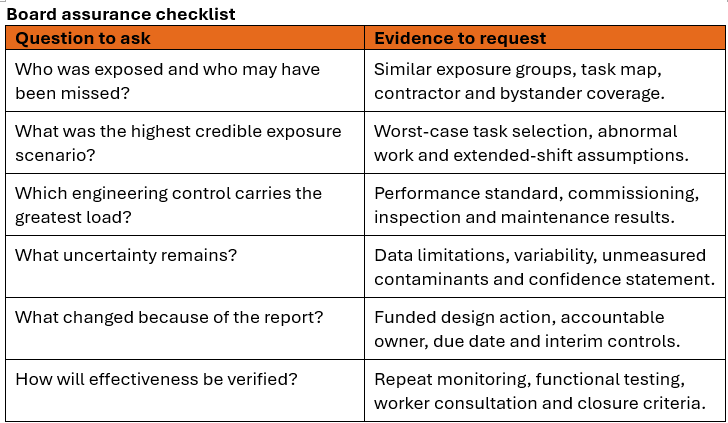
The board does not need to become an occupational hygiene committee. It does need to know when the organisation is relying on thin evidence. A strong report makes uncertainty visible, connects results to real work and creates a clear control decision. A weak report uses technical detail to avoid that decision.
Final Word
This July issue carries a simple message: the hazards that develop slowly still require fast governance.
A post driver attachment can fail in seconds, but the conditions that allow it to fail develop through design, vibration, maintenance and inspection. A chemical transfer can release without warning, but the vulnerability sits in the pump, hose, fitting, restraint and emergency arrangement long before the incident. Lead and welding fume may harm over months or years, but the exposure is created every shift through process choices, ventilation, worker position and the availability of effective protection.
The common mechanism is not a lack of information. It is fragmentation. Engineering owns the plant. Operations owns production. Procurement owns materials. HR or occupational health receives medical results. WHS owns the procedure. The board receives a status. When those functions do not share one risk picture, exposure sits between them.
The organisations that manage occupational health well do not wait for disease data to force action. They treat occupational hygiene as a design and assurance discipline. They use monitoring to test controls, not to defend existing practice. They act on uncertainty. They consult workers who understand the real task. They keep evidence that a control was not only purchased or documented, but working under normal and difficult conditions.
Choose one exposure risk this month. Go beyond the register. Identify the highest-exposure task. Confirm the engineering control is operating. Check who is outside the formal worker group but still in the plume, splash zone or release path. Review the monitoring result and ask what changed because of it.
If the answer is nothing, the report was an activity, not assurance.
Stay sharp. Stay accountable.
Niru Tyagi | WHS Guard
References
1. Queensland Government. (2026). Work Health and Safety Act 2011 (Qld), including officer due diligence duties under section 27. https://www.legislation.qld.gov.au/view/html/inforce/current/act-2011-018
2. International Organization for Standardization. (2018). ISO 45001:2018 Occupational health and safety management systems - Requirements with guidance for use. https://www.iso.org/standard/63787.html
3. International Organization for Standardization. (2021). ISO 45003:2021 Psychological health and safety at work - Guidelines for managing psychosocial risks. https://www.iso.org/standard/64283.html
4. Workplace Health and Safety Queensland. (2026, July 7). Tractor-mounted post driver failure. https://www.worksafe.qld.gov.au/news-and-events/alerts/workplace-health-and-safety-alerts/2026/tractor-mounted-post-driver-failure
5. Workplace Health and Safety Queensland. (2026, June 16). Two workers exposed to hazardous chemical. https://www.worksafe.qld.gov.au/news-and-events/alerts/incident-alerts/2026/two-workers-exposed-to-hazardous-chemical
6. Workplace Health and Safety Queensland. (2021). Managing risks of hazardous chemicals in the workplace Code of Practice 2021. https://www.worksafe.qld.gov.au/safety-and-prevention/creating-safe-work/codes-of-practice/managing-risks-of-hazardous-chemicals-in-the-workplace-code-of-practice-2021
7. SafeWork NSW. (2026, July 17). Company director fined $195,500 after doctor exposed to hydrogen sulphide gas. https://www.safework.nsw.gov.au/news/safework-media-releases/company-director-fined-%24195%2C500-after-doctor-exposed-to-hydrogen-sulphide-gas
8. WorkSafe Victoria. (2026, July 1). Bendigo lab fined $10,000 over lead testing failures. https://www.worksafe.vic.gov.au/news/2026-07/bendigo-lab-fined-10000-over-lead-testing-failures
9. Safe Work Australia. (2026, July 13). Have your say on protecting workers from exposure to lead. https://www.safeworkaustralia.gov.au/media-centre/news/have-your-say-protecting-workers-exposure-lead
10. Australian Institute of Occupational Hygienists. (2026, March 4). Simplified Occupational Hygiene Risk Management Strategies, third edition. https://www.aioh.org.au/news/new-simplified-occupational-hygiene-risk-management-strategies-third-edition-now-available
11. Press Information Bureau, Government of India. (2026, May 7). Union Minister launches nationwide annual health check-up initiative for workers under Labour Codes. https://www.pib.gov.in/PressReleasePage.aspx?PRID=2258662&lang=1®=3
12. Ministry of Labour and Employment, Government of India. (2026). Occupational Safety, Health and Working Conditions (Central) Rules, 2026 and implementation materials. https://www.labour.gov.in/offerings/schemes-and-services/details/labour-codes-gzNzQzMtQWa
13. Driscoll, T. R., Paine, S., Fritschi, L., Nguyen, H., & Carey, R. N. (2026). Occupational exposure to welding fume in Australian workplaces. Industrial Health, 64(2), 137-148. https://doi.org/10.2486/indhealth.2025-0048
14. Carey, R. N., Fritschi, L., Abdallah, K., & Driscoll, T. R. (2024). Occupational exposure to welding fume in Australia: An online survey. Australian and New Zealand Journal of Public Health, 48(4), 100165. https://doi.org/10.1016/j.anzjph.2024.100165
15. Safe Work Australia. (2026). Welding fumes. https://www.safeworkaustralia.gov.au/safety-topic/hazards/welding-fumes
16. Safe Work Australia. (2026). Workplace Exposure Limits - airborne contaminants. https://www.safeworkaustralia.gov.au/safety-topic/managing-health-and-safety/workplace-exposure-limits-airborne-contaminants
17. Safe Work Australia. (2026). Changes between the Workplace Exposure Standards and Workplace Exposure Limits. https://www.safeworkaustralia.gov.au/safety-topic/managing-health-and-safety/workplace-exposure-limits-airborne-contaminants/changes-between-wes-and-wel
18. International Agency for Research on Cancer. (2018). Welding, molybdenum trioxide, and indium tin oxide. IARC Monographs, Volume 118. https://publications.iarc.who.int/569